Cannabis Advertising in 2026: A State-by-State Compliance Map
Cannabis Advertising in 2026: A State-by-State Compliance Map Imagine this: You’ve spent three months and fifty thousand dollars crafting the perfect video campaign for your new line of live resin gummies. The creative is gorgeous, the message is on-brand, and your team is ready to celebrate. The
Imagine this: You’ve spent three months and fifty thousand dollars crafting the perfect video campaign for your new line of live resin gummies. The creative is gorgeous, the message is on-brand, and your team is ready to celebrate. Then, forty-eight hours after launch, you get the email every marketer dreads. Your accounts are flagged, your ads are pulled, and your legal team is staring at a six-figure fine from a state regulator you didn’t even know had jurisdiction over your digital spend.
Sound like a nightmare? For many in the industry, it’s just a Tuesday. As we move through 2026, cannabis advertising compliance has become less of a hurdle and more of a high-stakes chess match. With more states joining the legal ranks and federal rescheduling still caught in a bureaucratic tug-of-war, the "rules of the road" change every time you cross a state line—or even a county border.
According to recent industry data, cannabis ad spending is projected to hit $3.2 billion by the end of 2026, yet nearly 40% of digital cannabis ads are still rejected by platforms due to compliance errors. How do you scale your brand without getting sidelined by the regulators? Let’s break down the 2026 landscape so you can keep your creative live and your budget working.
The Federal Paradox: Why 2026 Still Feels Like 2016
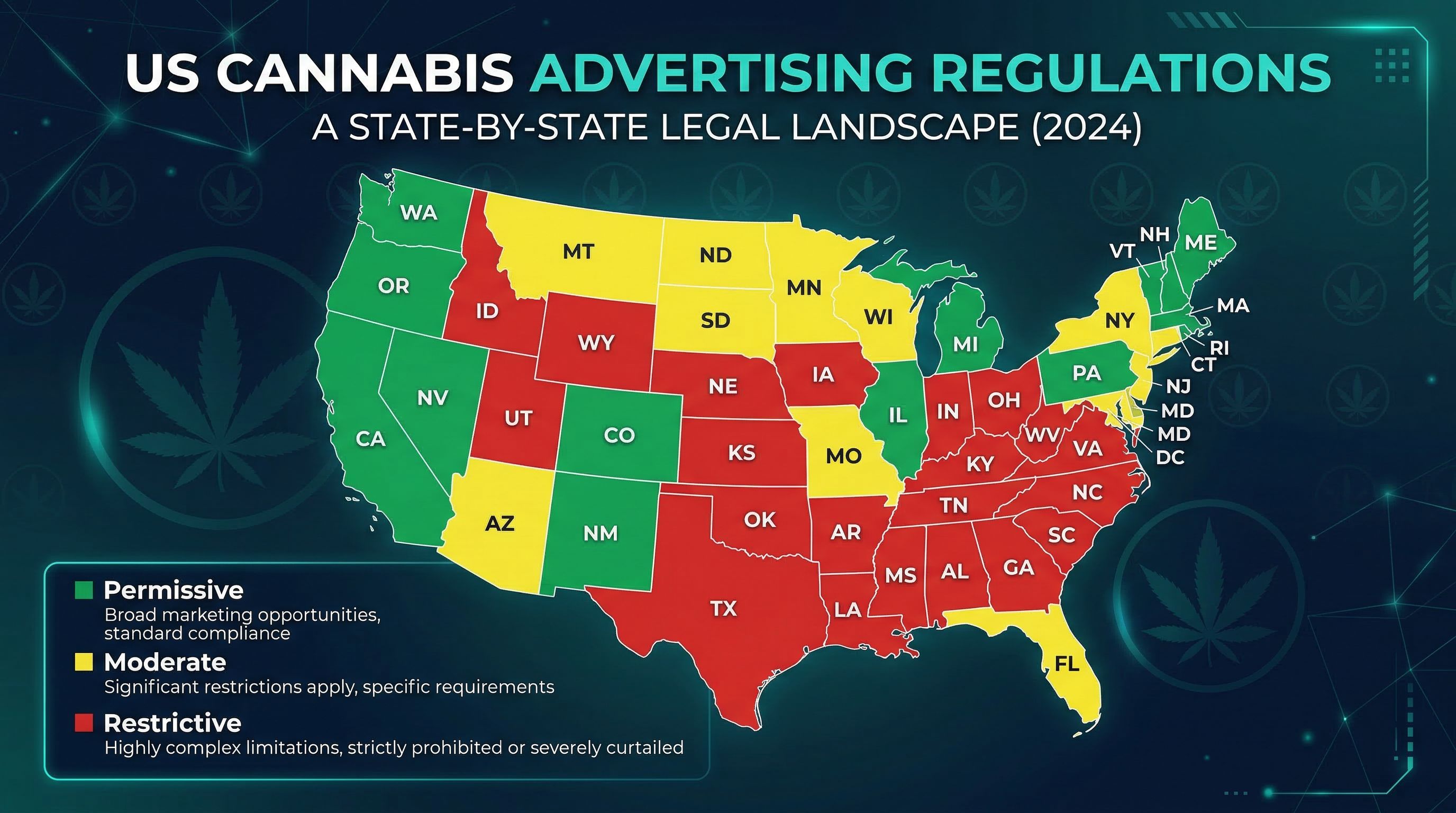
You’d think by 2026 we would have a unified national standard, wouldn't you? Unfortunately, despite incremental progress in banking and research, the advertising world remains a fragmented patchwork. Because cannabis remains a controlled substance at the federal level, the FCC and FTC haven't issued a "gold standard" for marijuana advertising regulations. This leaves the heavy lifting to the states.
This fragmentation means that a billboard that is perfectly legal in Denver could get you a "cease and desist" order in Chicago. The lack of federal oversight doesn't mean there are no rules; it means there are fifty different sets of rules. In 2026, the primary challenge isn't just knowing the law—it's managing the nuances of those laws at scale.
Did you know that in 2025, over 65% of cannabis businesses reported that "regulatory uncertainty" was their primary barrier to digital growth? When you're managing a multi-state operation (MSO), that uncertainty doesn't just slow you down; it eats your ROI. You aren't just a marketer anymore; you're a compliance officer with a creative streak.
The West Coast: The Mature Markets Get Strict
California, Oregon, and Washington are the "old guard" of the industry. You might assume that because they’ve been legal longer, they’d be more relaxed. In reality, it’s the opposite. These states have spent years refining their cannabis ad rules by state, and they have the enforcement budgets to prove it. In California, the Department of Cannabis Control (DCC) has ramped up its automated monitoring of social media influencers.
The "71.5% rule" remains the holy grail here. You must have "reliable evidence" that at least 71.5% of the audience for any given ad is reasonably expected to be 21 years of age or older. But in 2026, "reliable evidence" means more than just a pinky swear from a publisher. It means verified third-party demographic data. If you can't prove who saw the ad, you shouldn't have run it.
In Washington state, the rules around "appealing to minors" have become incredibly granular. We’re talking about bans on specific shades of neon and certain fonts that might look too much like a popular cereal brand. A single cartoonish leaf or a "cool" mascot can result in a license suspension. Are you checking your hex codes against state-specific "youth-appealing" palettes?
The Northeast: High Stakes and High Restrictions
If the West Coast is about audience data, the Northeast is about lifestyle. New York and New Jersey have some of the most lucrative markets in the country, but their dispensary advertising rules are notoriously tight. New York, in particular, has a strict ban on "lifestyle" branding that portrays cannabis use as "glamorous" or "cool."
Think about that for a second. The very thing that makes modern marketing work—selling an aspiration—is often illegal in the Empire State. You can show the product (with strict labeling), and you can show the store, but you can’t show a group of friends laughing at a party with a pre-roll. It’s a functional approach to marketing that forces you to be creative within a very small box.
Statistically, New York’s Office of Cannabis Management (OCM) issued over $2 million in advertising-related fines in the last fiscal year alone. Most of these weren't for "bad" ads, but for technicalities: missing license numbers, font sizes on warnings being too small, or ads placed too close to a "prohibited location" like a playground or a library. Is your geo-fencing tight enough to exclude every school in a five-mile radius?
The Midwest: The New Growth Engine
The Midwest is currently the most exciting region for cannabis advertising compliance. With Ohio’s market maturing and Illinois maintaining high volumes, the "Rust Belt" has become a green belt. However, Illinois has some of the most restrictive "distance" laws in the country. You cannot advertise within 1,000 feet of a school, park, or "area where children congregate."
In a dense city like Chicago, those 1,000-foot bubbles overlap so much that outdoor advertising becomes a literal minefield. This has pushed most brands into the digital space, where the battle for attention is fierce. But even online, the Midwest regulators are watching. Michigan, for example, has strict rules about "curative or therapeutic" claims. You can't say your product helps with sleep or anxiety without a mountain of FDA-approved evidence—which, as we know, doesn't exist yet for cannabis.
Interestingly, Ohio has seen a 45% increase in "digital-only" dispensary launches in 2026. These brands are skipping billboards entirely to avoid the physical compliance headache, opting instead for programmatic display and SEO. But even then, they face the hurdle of "platform-specific" compliance, which can be even more fickle than state law.
Digital Giants: Navigating Meta, Google, and X
How many times have you had an ad account "shadowbanned" or disabled without explanation? Even in 2026, the big tech platforms are playing it safe. Google and Meta have loosened their grip slightly, allowing for topical hemp and some CBD ads, but THC remains the third rail of digital marketing. If you're running dispensary advertising, you’re likely using "workarounds"—landing pages that don't mention the "C-word" or creative that focuses on "botanicals."
But the AI used by these platforms has gotten smarter. In 2026, Meta's "Creative Intelligence" bots can identify a cannabis leaf even if it’s blurred or stylized. They can read the metadata of your images. They can even analyze the "sentiment" of your landing page. If your tech stack isn't as smart as their enforcement bots, you're going to lose your accounts.
X (formerly Twitter) remains the most "cannabis-friendly" of the major social platforms, but even they require pre-authorization and strict geo-targeting. The data shows that brands using "compliance-first" creative—ads designed specifically to pass AI filters—see a 300% higher retention rate for their ad accounts compared to those who try to "sneak" traditional creative through the system.
The Hidden Danger: The "One-Size-Fits-All" Creative
One of the biggest mistakes we see in 2026 is the "National Creative" approach. A brand creates one beautiful set of assets and tries to run them in five different states. This is a recipe for disaster. What works in Arizona (where you can show human models) will get you banned in Connecticut (where you often can't). Cannabis advertising compliance requires a modular approach to creative.
You need to think of your ads like LEGO sets. The core brand message stays the same, but the "compliance blocks"—the warnings, the imagery, the disclosures—need to be swapped out based on the zip code of the viewer. This is where manual workflows fall apart. No human marketing team can manage 500 variations of an ad for 15 different state jurisdictions without making a mistake.
A recent survey of MSO marketing directors found that "manual compliance review" takes up an average of 15 hours per week per employee. That’s time that should be spent on strategy and storytelling, not squinting at state statutes to see if a font is 6-point or 8-point. Are you still relying on a spreadsheet and a prayer to stay compliant?
The Rise of AI in Compliance Automation
This is where the industry is shifting. In 2026, the most successful brands aren't just hiring more lawyers; they’re hiring AI. Automation is the only way to keep up with the velocity of digital advertising. If you're running programmatic ads that refresh every 24 hours, you need a compliance check that happens in milliseconds, not days.
AI-powered platforms can now scan an ad creative, compare it against a database of marijuana advertising regulations for a specific state, and flag potential violations before the ad is ever uploaded to a DSP (Demand Side Platform). This isn't just about avoiding fines; it's about speed-to-market. In a competitive landscape, being the first to react to a market trend can be the difference between a record-breaking quarter and a stagnant one.
At Hawtads, we’ve seen how this tech changes the game. By automating the "boring but critical" parts of compliance, brands can finally focus on being brands again. Imagine a world where your creative team can "set it and forget it," knowing that the AI will catch the wrong warning label or the prohibited image before it ever hits a consumer’s screen. That’s the 2026 standard.
The 2026 Compliance Checklist: Five Pillars of Safety
Before you hit "launch" on your next campaign, run it through this five-pillar framework. These are the universal truths of cannabis advertising compliance in 2026, regardless of which state you're targeting:
- The Audience Threshold: Do you have a third-party data report proving a 71.5%+ adult audience?
- The "No-Go" Zone: Have you verified your geo-fencing against the latest "prohibited location" maps (schools, parks, etc.)?
- The Minor Factor: Does your creative use any colors, fonts, or characters that could be interpreted as appealing to children? (When in doubt, take it out).
- The Claim Check: Are you making any health or "wellness" claims that haven't been vetted by legal? (Avoid words like "cure," "treat," or "heal").
- The Mandatory Block: Does every single frame of your video or every slide of your carousel include the state-required warnings and license numbers?
Missing just one of these pillars doesn't just put your ad at risk—it puts your entire business license at risk. In 2026, regulators are increasingly using a "three strikes" rule for advertising violations. Don't let a sloppy graphic design choice be the reason you lose your right to operate.
The Future: Dynamic Compliance and Beyond
Looking ahead to 2027 and 2028, the trend is clear: cannabis ad rules by state will only become more automated. We expect to see "smart licenses" where your ability to buy ad space is digitally linked to your compliance record. If you have a clean record, you get lower rates and faster approvals. If you’re a "high-risk" advertiser, you’ll face manual reviews and higher barriers to entry.
The "wild west" days are over. The winners in the next phase of the cannabis industry will be the ones who treat compliance as a competitive advantage rather than a chore. When your competitors are getting their accounts shut down, your ability to remain visible to your customers is your most valuable asset.
Are you ready to stop playing defense and start playing offense with your marketing? The tools are there, the data is there, and the audience is certainly there. You just need the right system to navigate the maze.
Making Compliance Your Secret Weapon
Navigating the 2026 map of cannabis advertising compliance doesn't have to be a solo mission. While the regulations are complex, the goal is simple: reach your customers where they are, with a message they love, without getting shut down. It’s about building trust—not just with your audience, but with the platforms and regulators who hold the keys to your growth.
At Hawtads, we’ve built the industry’s leading AI-powered engine to handle the heavy lifting of compliance and creative automation. We help you bridge the gap between "great creative" and "compliant creative" in seconds. Instead of worrying about whether your ad meets New Jersey’s specific font requirements or Illinois’ distance rules, you can focus on what you do best: growing your brand.
Ready to take the stress out of your cannabis ad campaigns? Explore how Hawtads can automate your compliance workflow and keep your brand in front of the people who matter most. Let’s make 2026 the year your advertising finally scales without limits.