
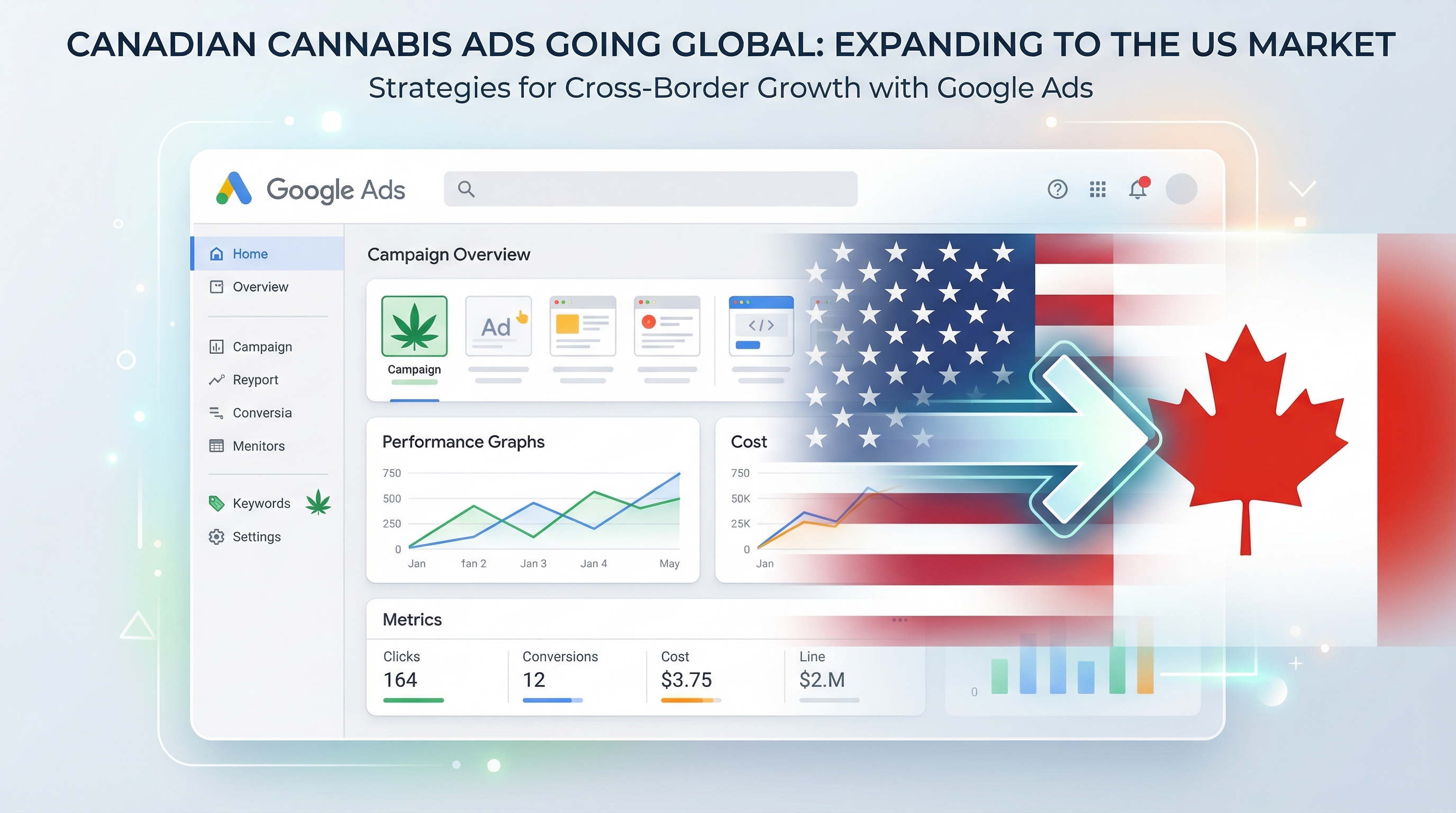
Cannabis Brands on Google Ads: The Canadian Pilot Program and What It Means for the US
You’ve spent weeks perfecting your creative. The copy is punchy, the visuals are on-brand, and your landing page is optimized for conversions. You hit "Publish" on your latest campaign, feeling a surge of excitement. Then, the dreaded email hits your inbox: "Account Suspended: Policy Violation."
You’ve spent weeks perfecting your creative. The copy is punchy, the visuals are on-brand, and your landing page is optimized for conversions. You hit "Publish" on your latest campaign, feeling a surge of excitement. Then, the dreaded email hits your inbox: "Account Suspended: Policy Violation."
For most marketers, this is a minor setback. For those in the cannabis industry, it’s a Tuesday. Navigating Google Ads cannabis policies has historically felt like walking through a minefield blindfolded. But what if the blindfold was finally starting to slip?
In early 2023, Google quietly opened a door that had been bolted shut for over a decade. By launching a pilot program for cannabis-related ads in Canada and specific CBD products in the US, the search giant signaled a massive shift in its philosophy. This isn't just a win for our neighbors to the north; it’s a roadmap for what’s coming to the United States.
According to recent industry reports, Google processes over 8.5 billion searches per day, yet cannabis brands have been largely excluded from this massive intent-based traffic. Are you ready to claim your share of the search results, or will you be left behind when the floodgates finally open?
The Canadian Pilot Program: A Testing Ground for the World
In January 2023, Google updated its Healthcare and Medicines policy to allow for the promotion of recreational cannabis in Canada. This wasn't a "wild west" free-for-all, but rather a strictly regulated pilot program designed to see if cannabis brands could play by the rules. For the first time, licensed producers and retailers could bid on keywords that were previously blacklisted.
Why Canada? It’s simple: federal legalization. Because cannabis is legal across the entire country, Google doesn't have to navigate the patchwork of conflicting state and federal laws that currently plague the US market. This makes Canada the perfect laboratory for cannabis PPC advertising.
The results have been eye-opening. Data shows that nearly 70% of Canadians live within 10 kilometers of a legal cannabis retail store. By allowing dispensary Google Ads, Google is helping these local businesses connect with consumers who are actively looking for their products, rather than forcing them to rely solely on organic SEO or expensive billboard campaigns.
The LegitScript Hurdle
If you think you can just log into your dashboard and start bidding on "best sativa," think again. The Canadian pilot program introduced a mandatory gatekeeper: LegitScript. To run ads, brands must undergo a rigorous certification process to prove they are licensed and compliant with local regulations.
This certification is more than just a rubber stamp. It requires a deep dive into your business practices, your supply chain, and your digital presence. Google is essentially outsourcing its compliance worries to a third party that specializes in high-risk industries. Have you considered how your current documentation would hold up under that kind of scrutiny?
LegitScript charges a significant fee for this certification, which acts as a barrier to entry. While it keeps the platform "clean," it also means that Google Ads cannabis remains a "pay-to-play" game where only the most professional and compliant brands survive. This is a trend we expect to see mirrored in the US as soon as federal restrictions ease.
What This Means for the US Market
While Canada is enjoying the limelight, US-based brands are watching closely. Currently, Google’s US policy is much more restrictive, primarily allowing only hemp-derived CBD products with a THC content of 0.3% or less. However, the Canadian pilot is the "canary in the coal mine" for the American landscape.
The US legal cannabis market is projected to reach a staggering $71 billion by 2030. Google knows this. They are a business, after all, and they don't want to leave billions of dollars in potential ad revenue on the table indefinitely. The Canadian program is their way of building the infrastructure and automated systems needed to police cannabis ads at scale before the US goes green.
Are you prepared for the day the "THC" ban is lifted in the US? Most brands aren't. They are waiting for the law to change before they build their strategy. But the brands that win will be the ones who have already mastered the art of "compliant-adjacent" marketing—learning the nuances of Google’s AI-driven moderation today so they can dominate tomorrow.
The Rescheduling Ripple Effect
One of the biggest hurdles for Google Ads cannabis in the US is the federal classification of marijuana. However, with the Department of Health and Human Services (HHS) recommending that cannabis be moved from Schedule I to Schedule III, the legal landscape is shifting beneath our feet. A move to Schedule III would acknowledge the medical utility of cannabis and potentially open the door for much broader advertising permissions.
If rescheduling happens, Google’s "Legalize it" policy for Canada could be ported over to the US faster than you might think. We’ve already seen Google soften its stance on CBD ads in California, Colorado, and Puerto Rico. The momentum is building, and the data suggests that search intent for "dispensaries near me" is at an all-time high.
Do you have a plan for when your competitors suddenly appear at the top of the search results? The transition from "prohibited" to "regulated" happens in an instant. If you aren't already thinking about your cannabis PPC advertising strategy, you’re already behind the curve.
The Compliance Nightmare: Why Google is So Strict
To understand the future, we have to understand Google’s fear. Google’s primary concern isn't the morality of cannabis; it’s the liability. They operate in hundreds of jurisdictions, each with its own set of rules. If they allow an ad that violates a local law, they face massive fines and potential legal action.
This is why their AI-driven ad review systems are set to "ultra-sensitive" for regulated industries. Even if your ad is technically legal, a single word or image that triggers the algorithm can lead to an account-wide ban. It’s a "guilty until proven innocent" ecosystem.
For example, using images of people consuming the product, showing "excessive" amounts of flower, or making unsubstantiated health claims are all "red flag" behaviors. Even something as simple as your landing page having a "Buy Now" button for a restricted product can get your entire Google Ads account nuked. This is where automation and AI-powered compliance tools become your best friend.
The High Cost of Manual Compliance
Many brands try to manage compliance manually, having a team member review every single ad against a checklist. But humans make mistakes, and Google’s policies change almost weekly. Statistics show that manual ad compliance checks can take up to 30% of a marketing team's time—time that could be spent on strategy and creative.
Furthermore, the cost of an ad disapproval isn't just the lost time; it’s the damage to your "Account Health" score. Google keeps a hidden record of your compliance history. The more disapprovals you have, the harder it becomes to get any ad approved in the future. You are essentially teaching Google's AI that your brand is "high risk."
How much revenue are you losing every day your ads are offline? For a mid-sized dispensary, even 48 hours of downtime during a peak period like 4/20 can result in tens of thousands of dollars in lost sales. This is why platforms like Hawtads are becoming essential for brands that want to scale without the constant fear of suspension.
Creative Best Practices in a Regulated World
If you want to succeed in dispensary Google Ads, you have to learn to speak "Google-ese." This means creating ads that convey your brand's value without triggering the automated "narc" bots. It’s a delicate dance between being evocative and being safe.
In Canada, successful brands have moved away from the "stoner" aesthetic and toward a "wellness and lifestyle" approach. They focus on the benefit rather than the burn. Instead of showing a close-up of a terpene-rich bud, they show a person enjoying a peaceful evening or a social gathering where their product fits naturally.
- Focus on Education: Instead of "Buy 1/8th of OG Kush," try "Learn about the differences between Indica and Sativa."
- Use Neutral Language: Avoid slang. Use clinical or professional terms where appropriate.
- Optimize Your Landing Pages: Google doesn't just look at your ad; it looks at where the ad leads. Ensure your landing page is as compliant as your creative.
- Leverage Video: Short, compliant video ads often have higher engagement and can bypass some of the text-based keyword filters that plague static ads.
Remember, the goal of a Google Ads cannabis campaign isn't always a direct sale. Sometimes, it’s about brand awareness and capturing email addresses so you can market to them on platforms you actually own. Are you using search ads to build your "owned" audience, or are you putting all your eggs in a basket Google can take away at any moment?
The Power of "Informational" Search
One of the most effective ways to use Google Ads right now—even in the US—is to bid on informational keywords. People are constantly searching for things like "how to dose CBD for sleep" or "what is a terpene?" By providing high-quality, compliant answers to these questions, you build trust and authority.
Data indicates that consumers are 131% more likely to buy from a brand after reading educational content from them. By positioning your brand as an educator rather than just a seller, you make it much harder for Google to find a reason to ban you. You aren't "selling drugs"; you’re "providing health and wellness information."
The Future of Cannabis PPC: AI and Automation
As the Canadian pilot matures and the US inches closer to federal reform, the volume of cannabis ads is going to explode. When that happens, manual management will be impossible. The brands that dominate the search results will be the ones using AI to manage their creative and compliance at scale.
Imagine a system that automatically scans your ad creative against the latest Google policies before you ever hit "submit." A system that can tweak your copy to be 5% safer while maintaining 100% of its impact. This isn't science fiction; it’s the necessary evolution of the industry.
Google itself is heavily invested in AI (look at Performance Max campaigns). To beat the machine, you have to use the machine. You need tools that understand the specific nuances of cannabis regulations—tools that know the difference between a "promotion" and a "product description" in the eyes of a regulator.
Data-Driven Compliance
In the near future, compliance won't just be about avoiding bans; it will be about optimizing for "deliverability." Just because an ad is approved doesn't mean it’s being shown to your full target audience. Google often "shadow bans" or limits the reach of ads it deems "borderline."
By using data-driven compliance tools, you can identify which types of creative get the best "Quality Score" from Google’s bots. A higher Quality Score means lower costs per click (CPC) and better ad placement. In a competitive market like cannabis PPC advertising, a 10% reduction in CPC can mean the difference between a profitable campaign and a money pit.
How much data are you currently collecting on your ad approvals? Do you know which specific words trigger a "limited" status for your account? If you aren't tracking this, you’re flying blind in a storm.
Actionable Takeaways for Your Brand
The Google cannabis ad pilot in Canada is a gift to US marketers. It’s a preview of the rules, the hurdles, and the opportunities that are coming our way. Here is how you can start preparing today:
- Audit Your Current Assets: Review your website and social media. Are you using language that would be flagged by a LegitScript-style review? Start cleaning up your "digital house" now.
- Monitor the Canadian Market: Watch what the big Canadian players like Canopy Growth or Tilray are doing with their search ads. They are the ones paying for the "lessons" that you can learn for free.
- Build an Educational Content Moat: Start creating compliant, informational content that targets high-intent search terms. This builds your SEO and prepares your account for future PPC success.
- Invest in Compliance Technology: Don't wait for a suspension to realize that manual compliance doesn't scale. Look for tools that can automate the "safety check" of your marketing workflow.
The landscape of Google Ads cannabis is changing rapidly. What was impossible yesterday is a pilot program today and will be the industry standard tomorrow. The question isn't whether Google will fully embrace cannabis advertising, but whether your brand will be ready to lead the charge when they do.
Navigating these waters is complex, but you don't have to do it alone. At Hawtads, we’ve built an AI-powered platform specifically designed to help brands in regulated industries stay ahead of the curve. We handle the heavy lifting of creative compliance and ad automation, so you can focus on what you do best: growing your brand and serving your customers.
Ready to see how AI can future-proof your cannabis advertising strategy? Let’s chat about how we can help you navigate the ever-changing world of Google Ads with confidence.