
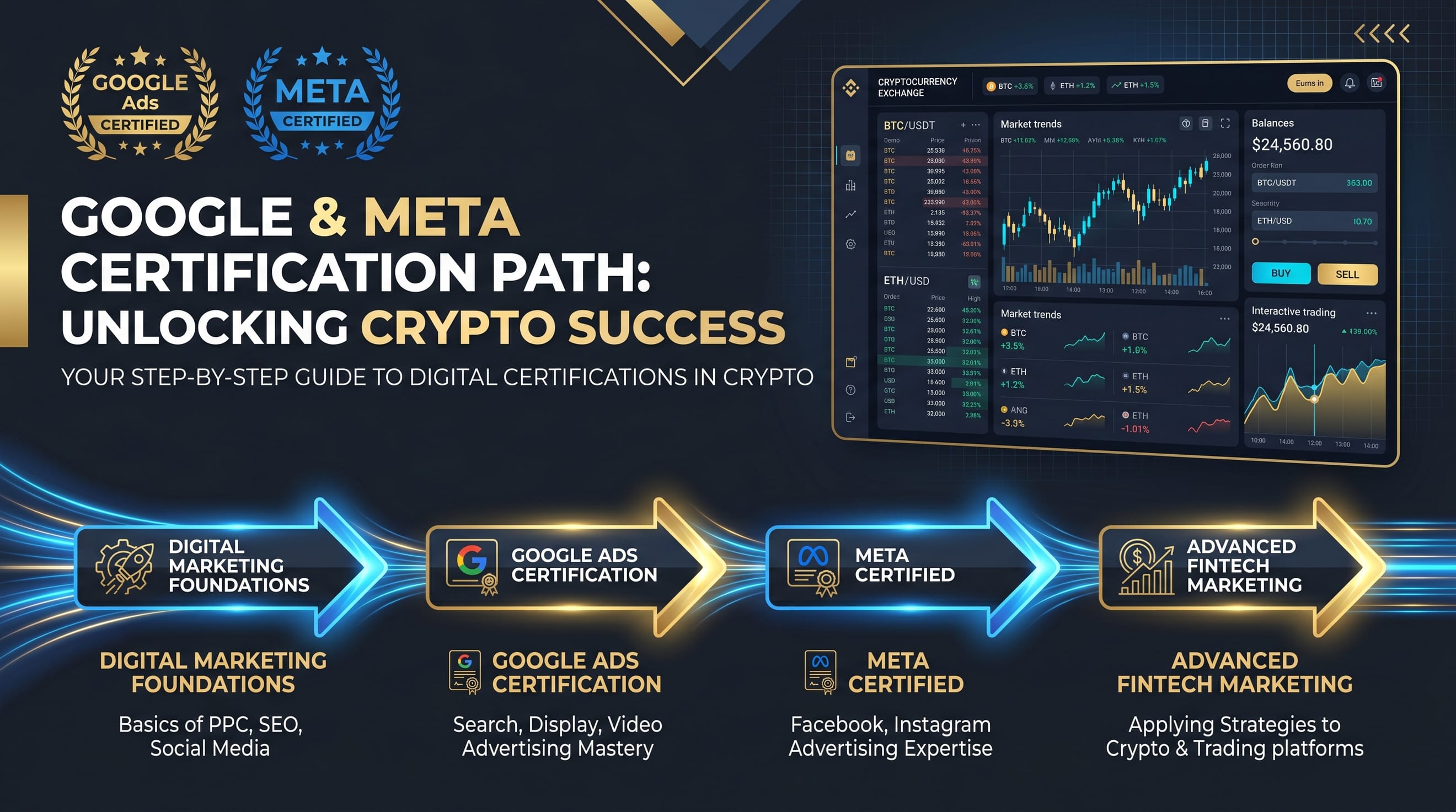
Crypto Exchange Advertising: Getting Certified on Google and Meta
Imagine this: You’ve spent three weeks perfecting your new exchange’s user interface, your liquidity is deep, and your marketing team has designed a set of "scroll-stopping" ads. You hit "Publish" on Google and Meta, leaning back to watch the conversions roll in. Instead, two hours later, you receiv
Imagine this: You’ve spent three weeks perfecting your new exchange’s user interface, your liquidity is deep, and your marketing team has designed a set of "scroll-stopping" ads. You hit "Publish" on Google and Meta, leaning back to watch the conversions roll in. Instead, two hours later, you receive a notification that chills every crypto marketer to the bone: "Account Suspended: Policy Violation."
If you’ve spent any time in the Web3 space, you know that crypto exchange ad certification isn't just a hurdle; it’s a high-stakes obstacle course. The digital advertising giants have transitioned from a total ban in 2018 to a complex, highly regulated "whitelist" system. Today, navigating these rules is the difference between scaling your user base and being permanently blacklisted from the world’s largest traffic sources.
Did you know that despite the growing mainstream adoption of Bitcoin, nearly 40% of financial services ad accounts experience at least one temporary suspension during their first year? The stakes are high, but the rewards for those who secure their Google Ads crypto certification and Meta approvals are even higher. Let’s dive into how you can navigate this process without losing your mind—or your ad account.
The Evolution of Cryptocurrency Ad Approval
Why is it so hard to get an ad approved? To understand the present, we have to look at the past. In the 2017 ICO boom, the industry was rife with "rug pulls" and exit scams. Google and Meta responded with a "burn the forest to save the trees" approach, banning almost all crypto-related content.
Fast forward to today, and the landscape has matured. Regulators like FinCEN in the US and the FCA in the UK have established clearer frameworks. Consequently, the platforms have opened the gates—but only for those who can prove they are playing by the rules. According to industry data, crypto ad spend on major platforms increased by over 150% year-over-year in 2023, signaling that the "certified" path is where the growth is.
Are you prepared to prove your legitimacy to a computer algorithm? That is essentially what the certification process entails. It’s a mix of legal documentation, technical compliance, and creative oversight.
Navigating the Google Ads Crypto Certification Process
Google is the king of search intent. When someone types "best crypto exchange to buy Ethereum," you want to be there. But to show up, you need that elusive Google Ads crypto certification. Google divides its requirements based on the type of product you offer: Exchanges, Wallets, or Hardware Wallets.
To get started, you must apply for certification in every specific country you plan to target. This is a common point of failure. You might be licensed in the United States, but that doesn't automatically give you the right to run ads in Germany or Japan. Each jurisdiction requires its own proof of local licensing or registration as a Money Services Business (MSB).
The "G2" Factor and Financial Services Verification
In many regions, Google now uses a third-party verification service called G2. This adds another layer to your cryptocurrency ad approval journey. You have to provide G2 with your corporate registration, proof of physical address, and evidence that you are authorized by the relevant financial regulator. Only after G2 gives the thumbs up will Google even look at your ad certification application.
Statistically, applications that include a direct link to a government-hosted registry (like the FinCEN MSB search) are processed 30% faster than those that only provide PDF screenshots. Accuracy is your best friend here.

Cracking the Code on Meta Crypto Advertising
Meta (Facebook and Instagram) has a slightly different philosophy. For a long time, they required a specific "Prior Written Permission" form. While they have expanded the number of regulatory licenses they recognize—from a measly 3 to over 27—the scrutiny remains intense.
If you are a crypto exchange, Meta wants to see that you are a regulated entity. They are particularly interested in your "Anti-Money Laundering" (AML) and "Know Your Customer" (KYC) protocols. If your landing page promises "No KYC Trading," you can kiss your Meta crypto advertising dreams goodbye. Meta’s AI crawlers are specifically trained to flag phrases that suggest a lack of regulatory oversight.
The Importance of Page Transparency
One often overlooked aspect of Meta approval is the "health" of your Business Manager and Facebook Page. Does your page have a history of community guideline violations? Is your "About" section fully filled out with a link to your Terms of Service? Meta looks at the holistic presence of your brand, not just the individual ad. Accounts with a "Page Quality" score in the green are 50% more likely to pass the manual review phase of the certification.
Have you audited your Business Manager recently? Small errors in your tax ID or business address can lead to a "Mismatch" error that triggers an automated rejection, often without a clear explanation of why.
Why Your Application Might Get Ghosted (and How to Fix It)
Getting rejected is frustrating, but getting "ghosted" (where your application sits in "Pending" for weeks) is worse. Usually, this happens because of a discrepancy between your ad account data and your legal documents. If your ad account is registered to "CryptoX Inc." but your license is under "CX Holdings LLC," the system will flag it.
Another common pitfall is the landing page. Both Google and Meta employ "spiders" that crawl your entire website. If they find a single blog post from 2019 mentioning a "guaranteed return on investment," your crypto exchange ad certification will be denied. They view your entire domain as part of the "ad experience."
- Check your footer: Ensure it contains all necessary legal disclaimers.
- Verify your domain: Use Google Search Console and Meta Business Suite to prove ownership.
- Match your billing: The credit card on file should ideally match the business name on your license.
Data shows that 70% of delays in the cryptocurrency ad approval process are due to "administrative mismatches" rather than actual policy violations. Double-check your paperwork before hitting submit.

The Creative Compliance Trap: Post-Certification Reality
Let’s say you’ve done it. You have the "Certified" badge in your Google Ads dashboard. You’re in the clear, right? Not quite. Getting certified is like getting a driver's license; you still have to follow the rules of the road, or you’ll lose it.
In the world of Meta crypto advertising, every single creative asset you upload goes through a fresh round of AI-driven review. Even with certification, certain "trigger words" or visual elements can cause an ad to be disapproved. If you have too many disapproved ads in a short period, the platform may revoke your certification entirely.
What the AI is Looking For
The algorithms are designed to detect "deceptive trade practices." This includes:
- Images of "lambos" or excessive wealth.
- Claims of "beating the market."
- Countdown timers that create false urgency.
- Specific mentions of "moon" or "100x."
Research indicates that ads focusing on "security," "platform stability," and "educational resources" have a 45% higher approval rate than those focusing on "trading gains" or "low fees." It’s about positioning your exchange as a utility, not a casino.
How AI Automation Can Save Your Campaigns
This is where things get tricky for human teams. How do you ensure that 50 different ad variations all stay within the lines of a 40-page policy manual? This is exactly why we built Hawtads. By using AI-powered compliance checks, you can scan your creatives before they ever reach the Google or Meta reviewers. Think of it as a pre-flight check for your ads. If our AI flags a phrase that might jeopardize your crypto exchange ad certification, you can fix it in seconds.
Global Nuances: One Size Does Not Fit All
The crypto world is borderless, but advertising is not. The requirements for cryptocurrency ad approval in the United Kingdom are vastly different from those in the United Arab Emirates. For example, the UK’s Financial Conduct Authority (FCA) recently implemented strict "Financial Promotion" rules that require specific, large-font risk warnings on every single ad.
If you run an ad in the UK without the phrase "Don’t invest unless you’re prepared to lose all the money you invest," you aren't just violating Google’s policy—you’re breaking the law. Google and Meta are now acting as the "enforcement arm" for these local regulators. If you fail a local compliance check, they will often suspend your global account as a "precautionary measure."
Did you know that in 2023, the FCA issued over 450 warnings to firms for non-compliant crypto promotions? Staying updated on these regional shifts is a full-time job.
Scaling Your Exchange: Moving Beyond the Basics
Once your Google Ads crypto certification is active, the real work begins: scaling. Most exchanges start with Search ads because they are the easiest to get approved. However, the real volume lies in YouTube (Google Display Network) and Instagram Stories.
Video content is notoriously difficult to get past compliance. The AI "listens" to your voiceover and "reads" the text overlays. If your spokesperson says something as simple as "Join the future of finance," it might be flagged as an unsubstantiated claim. Successful exchanges use a "modular" creative approach—testing small variations of compliant scripts to see what resonates without triggering the "Policy Violation" alarm.
The Power of Retargeting
Certification allows you to use one of the most powerful tools in digital marketing: Retargeting. You can serve ads to people who visited your exchange but didn't complete their KYC. This is where the ROI lives. However, retargeting lists for crypto are under extra scrutiny. You must ensure your privacy policy explicitly mentions how you use data for advertising, or you risk a GDPR-related suspension that could tank your certification status.
Common Questions About Crypto Ad Certification
How long does the certification process take?
On average, the Google Ads crypto certification takes between 2 to 4 weeks, provided all your documentation is in order. Meta can be faster (7-10 days) but is often more "binary"—you are either approved or you are banned with very little feedback in between.
Do I need a license for every country?
Yes. If you are targeting the US, you need FinCEN registration. If you are targeting Canada, you need FINTRAC. Attempting to "geo-hack" your way around these requirements by using a VPN or masking your landing page will lead to a permanent "Circumventing Systems" ban, which is nearly impossible to appeal.
Can I advertise NFTs?
NFTs currently sit in a "gray area." If the NFT is purely for art or collectibles, the rules are more relaxed. However, if the NFT offers "fractional ownership" or functions like a security, Google and Meta will treat it exactly like a crypto exchange, requiring full certification.
Your Action Plan for Compliance Success
Navigating the world of crypto exchange ad certification doesn't have to be a nightmare. It requires a shift in mindset: treat the platforms as partners in compliance rather than enemies to be outsmarted. By being transparent, meticulous with your paperwork, and conservative with your creative claims, you can unlock the massive growth potential of Google and Meta.
Here is your 3-step takeaway:
- Audit your legal foundation: Ensure your MSB licenses and corporate registrations are up-to-date and match your ad account details perfectly.
- Clean your digital house: Remove any "get rich quick" language from your website, blog, and social media channels.
- Automate your safeguards: Use tools to monitor your ad creatives in real-time to prevent accidental policy "trips" that could jeopardize your hard-won certification.
The crypto market moves at lightning speed, but the wheels of ad platform bureaucracy move slowly. Don't let a simple creative error or a missing document sideline your exchange for months. At Hawtads, we’ve seen how the right technology can turn a compliance headache into a competitive advantage.
By automating the heavy lifting of creative review and staying ahead of platform changes, you can focus on what you do best: building the future of finance. Ready to see how AI can streamline your path to cryptocurrency ad approval? We’re here to help you navigate the maze.