
Multi-Market Ad Compliance: How to Adapt One Campaign for 10 Jurisdictions
The Global Rollout Dilemma: Excitement Meets Exhaustion Picture this: You’ve just wrapped up the most successful ad campaign your company has ever seen. The creative is stunning, the copy converts like crazy, and your cost-per-acquisition in the US market is at an all-time low. You’re riding high. T
The Global Rollout Dilemma: Excitement Meets Exhaustion
Picture this: You’ve just wrapped up the most successful ad campaign your company has ever seen. The creative is stunning, the copy converts like crazy, and your cost-per-acquisition in the US market is at an all-time low. You’re riding high.
Then, your CMO drops by your desk with a smile. "This is incredible," they say. "Let’s roll this exact campaign out to the UK, Germany, Brazil, Japan, and six other countries by the end of the quarter."
Suddenly, that feeling of triumph turns into a cold sweat. You aren't just looking at a translation project; you are staring down the barrel of a massive regulatory headache. Welcome to the complex world of multi market ad compliance.
If you work in a regulated industry like finance, iGaming, healthcare, or crypto, you know that a winning ad in one country can be a fast track to a lawsuit in another. Did you know that up to 45% of regulated ad campaigns face launch delays of a month or more strictly due to cross-border legal reviews?
You can’t just translate your winning English copy into German and call it a day. You have to adapt, twist, and mold that single campaign to fit the unique legal frameworks of ten entirely different jurisdictions.
The Hidden Costs of Cross Jurisdiction Advertising
Why is taking a campaign global so agonizingly difficult? Because regulatory bodies across the world do not talk to each other. They each have their own distinct agendas, consumer protection laws, and pet peeves.
What the Financial Conduct Authority (FCA) demands in the UK is vastly different from what the Securities and Exchange Commission (SEC) requires in the US. Add the Australian Securities and Investments Commission (ASIC) into the mix, and you suddenly have three completely different sets of rules for three countries that all speak the same language.
The stakes are incredibly high. Global regulatory fines in the financial and data sectors alone topped an eye-watering $5 billion last year. But fines aren't the only cost.
When you attempt cross jurisdiction advertising without a solid plan, you bleed money through inefficiency. Your creative team spends weeks churning out endless variations of the same banner ad. Your legal team becomes a bottleneck, spending hours redlining minor copy tweaks.
And worst of all? Your time-to-market crawls to a halt. By the time your campaign is finally approved in all ten jurisdictions, the market trend you were trying to capitalize on might already be over.
Why "Copy and Paste" Fails When You Localize Regulated Ads
One of the biggest mistakes marketers make is confusing translation with localization. Translation is changing the words. Localization is changing the context, the culture, and most importantly, the compliance.
When you localize regulated ads, you have to account for nuance. Let's say your US ad features a bold claim: "The #1 Trading App for Beginners." In the US, you might get away with this if you have a small disclaimer linking to an internal study.
Try running that exact translated copy in Germany. The BaFin (Germany's financial regulator) and strict local competition laws will likely flag it immediately unless it is verified by an independent, recognized third-party auditor.
Here are just a few elements that change drastically across borders:
- Disclaimer length and placement: Some countries require disclaimers to be a specific font size relative to the main headline.
- Risk warnings: In iGaming, the UK requires prominent "BeGambleAware" messaging, while other regions require entirely different addiction helpline numbers.
- Visual restrictions: Showing lifestyle imagery (like someone driving a sports car) to promote a financial product is strictly banned in several European jurisdictions as "misleading."
- Urgency triggers: Using phrases like "Act Now" or "Limited Time Offer" in regulated spaces can trigger immediate bans in certain Asian markets.
A recent industry report revealed that ads which are both culturally and legally localized see a 70% higher conversion rate than generic, blanket translations. Doing it right isn't just about avoiding fines; it's about driving revenue.

Step 1: Build a "Core" Master Campaign
So, how do you actually adapt one campaign for ten different countries without losing your mind? It starts before you even write the first line of copy. You must design the campaign with global fragmentation in mind.
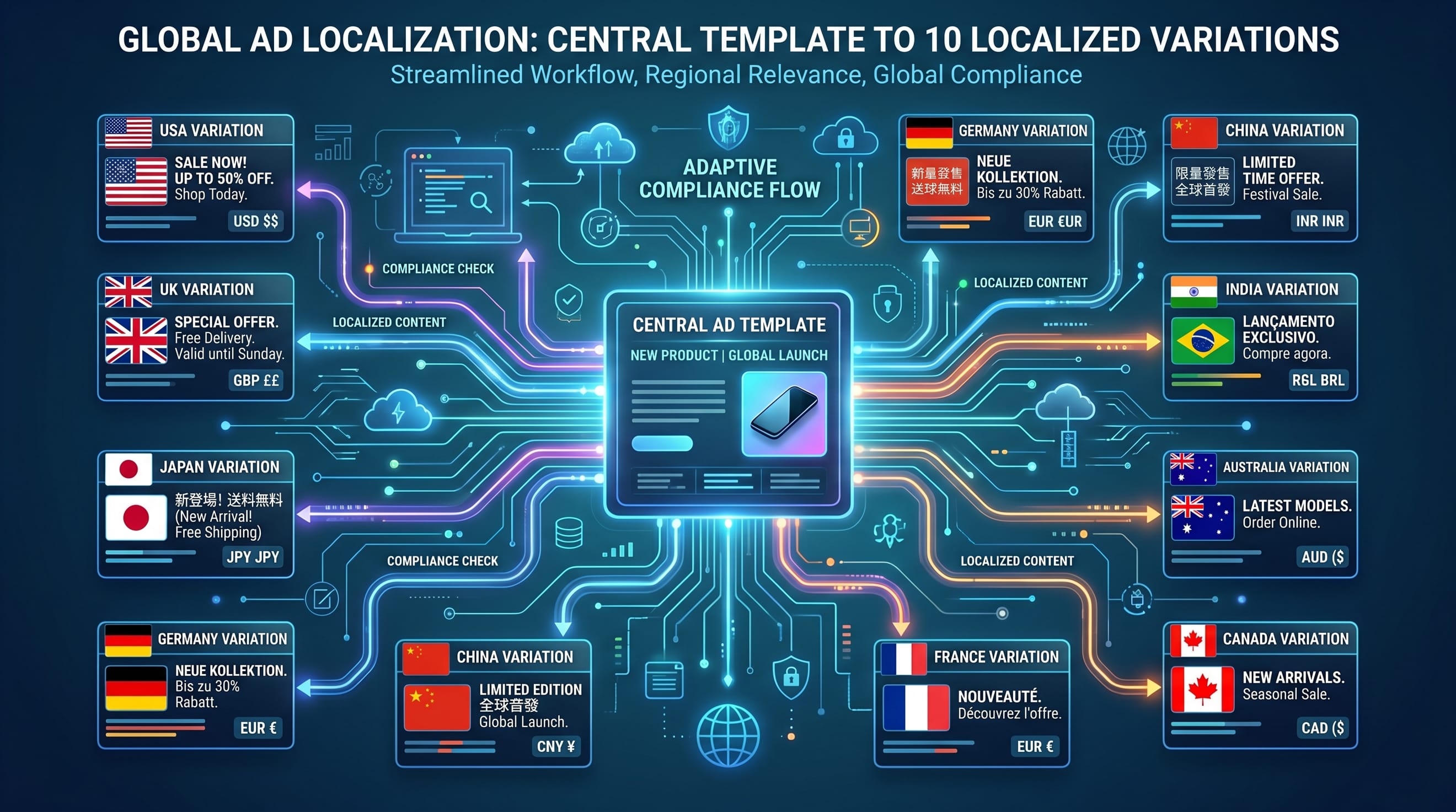
Instead of building a rigid, finished ad, you need to build a "Core Master Campaign." Think of this as a modular toolkit. You create a central visual concept, a core value proposition, and a flexible layout.
Don't bake your text directly into your image files. Leave plenty of negative space in your visual assets. Why? Because a required disclaimer in Spanish might take up 30% more space than the same disclaimer in English.
Data shows that utilizing a modular content creation strategy reduces global campaign rollout time by an average of 35%. By keeping your assets separated—backgrounds, character imagery, headlines, and legal text—you make it infinitely easier to swap elements in and out based on local laws.
Ask yourself: If a regulator forces me to remove this specific word or image, does the whole ad fall apart? If the answer is yes, your master campaign isn't flexible enough.
Step 2: Map the Regulatory Minefield
Before you hand anything over to your local teams, you need a map. Attempting global ad compliance without a centralized compliance matrix is like trying to navigate a new city blindfolded.
You need to sit down with your legal team and map out the specific "no-go" zones for all ten of your target jurisdictions. Create a shared document or database that clearly outlines the rules for each region.
For example, your matrix for a cryptocurrency campaign across ten regions might look something like this:
- US & Canada: Focus on state-by-state and province-by-province licensing disclosures.
- UK: Must include the exact FCA-mandated risk warning taking up a specific percentage of the screen. No incentives to invest.
- France: Requires AMF approval and specific language regarding digital asset service providers (DASP).
- Singapore: Strict limitations on advertising to retail investors in public spaces; digital ads require heavy risk disclosures.
Legal teams spend an average of 20 hours per week per region just reviewing ad copy for compliance. A centralized matrix cuts down this repetitive work by giving marketers a clear set of guardrails before they even start drafting.
Step 3: Platform Rules Compound Legal Rules
Just when you think you’ve mastered the government regulations for all ten jurisdictions, a new boss enters the arena: The ad platforms. Meta, Google, TikTok, and LinkedIn don't just enforce local laws; they enforce their own global policies.
Platform policies often act as a secondary, sometimes more restrictive, layer of multi market ad compliance. Google might allow a specific type of financial trading ad in Australia based on local law, but completely ban it on their platform globally due to their own internal risk assessments.
TikTok, for instance, has famously strict, blanket bans on various types of regulated advertising that might be perfectly legal in the target country. You have to thread the needle between what the country allows and what the algorithm will tolerate.
Did you know that over 60% of ad account bans in regulated sectors stem from algorithmic misunderstandings of local compliance nuances? A bot scans your ad, misinterprets a localized financial term as a policy violation, and shuts down your entire account.
To survive this, your compliance matrix must include a column for platform-specific rules. You aren't just creating a "UK version" of your ad; you are creating a "UK Meta version" and a "UK Google version."
Step 4: Automate Global Ad Compliance
Let’s be honest. If you are manually checking the font size of disclaimers for 50 different ad variations across 10 countries, you are losing the game. Manual review simply does not scale.
Human error is inevitable when marketers and lawyers are fatigued. A missed word in a French translation or an outdated risk warning in a Japanese banner ad can slip through the cracks of a manual review process.
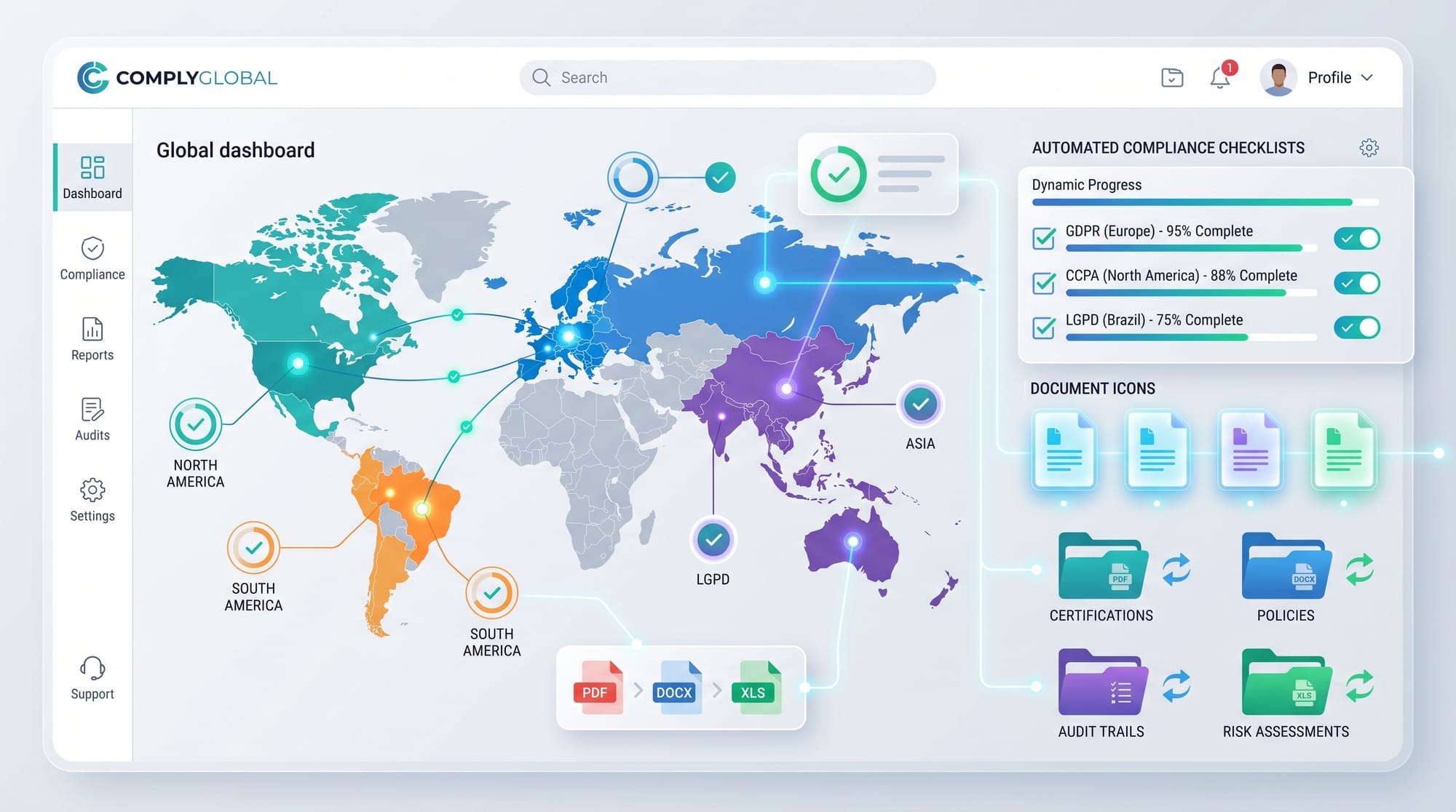
This is where technology changes everything. To truly master global ad compliance, you have to automate the busywork. Modern AI tools can now scan ad creatives, read the text within images, and cross-reference them against a database of global regulations in seconds.
Recent studies show that AI-driven compliance checks can reduce legal review bottlenecks by up to 80%. Imagine uploading your master campaign and having an AI instantly flag that your risk warning is 2% too small for the UK market, or that your imagery violates Spanish financial promotion laws.
By automating the initial compliance sweep, you free up your legal team to do what they do best: handle complex, nuanced legal strategy rather than acting as glorified proofreaders.
Step 5: The Visual Nuances of International Markets
We've talked a lot about copy and disclaimers, but what about the pictures? Visual compliance is often the silent killer of international ad campaigns.
What is considered a standard, high-performing stock photo in North America could be culturally offensive or legally problematic in the Middle East or parts of Asia. Even colors have different psychological and regulatory implications depending on where you are advertising.
In regulated industries, visual compliance goes even deeper. In many European countries, showing a person looking overly excited or wealthy in an ad for a high-risk financial product is viewed as predatory marketing.
Visual compliance violations account for nearly 30% of all rejected ads in regulated sectors. You must ensure your creative team understands that adapting an ad for a new jurisdiction often means swapping out the photography entirely.
When building your modular campaign, create a library of pre-approved, culturally neutral, and legally safe imagery for each of your ten target regions. This stops the endless back-and-forth when a local reviewer rejects an image.

Step 6: Establish a Bulletproof Feedback Loop
Even with the best automation and planning, you will still need human oversight. The relationship between your marketing team and your local legal counsels is the engine that drives multi-market success.
Too often, this relationship is adversarial. Marketing wants to push boundaries to get clicks; legal wants to pull back to minimize risk. When you are operating across ten jurisdictions, this friction multiplies exponentially.
You need to establish a clear Service Level Agreement (SLA) between marketing and legal. Define exactly what requires a full legal review and what is pre-approved. If marketing uses a pre-approved template with pre-approved localized disclaimers, they shouldn't need to wait two weeks for a lawyer's signature.
Companies with integrated, collaborative legal and marketing workflows launch their international campaigns 50% faster than those with siloed departments.
Create a centralized feedback loop. When the legal team in Brazil updates a regulation, that update should immediately flow into your central compliance matrix and update the rules for your automated screening tools. Knowledge cannot live in email threads; it must live in a central system.
Case Study Scenarios: The 10-Jurisdiction Breakdown
To truly grasp the scope of adapting one campaign, let's look at a hypothetical rollout for a regulated trading app. How does the same core message fracture across ten different legal landscapes?
The English-Speaking Giants: US, UK, Australia
You might think sharing a language makes this easy. It doesn't. In the US, you are navigating SEC rules, ensuring your performance claims are heavily substantiated. In the UK, the FCA demands that your risk warning is prominent, clear, and takes up a specific portion of the ad real estate. Meanwhile, in Australia, ASIC has recently cracked down on "finfluencer" style marketing, meaning your casual, user-generated content style ad might get blocked entirely.
The European Bloc: Germany, France, Spain, Italy
Here, you face the overarching umbrella of GDPR for data privacy, but individual financial promotions are still handled locally. Germany’s BaFin is notoriously strict on the tone of financial ads—they must be objective and devoid of hype. France’s AMF requires specific registration numbers to be visible. Spain recently introduced incredibly strict rules on crypto advertising, requiring a mandatory 10-day pre-notification for mass campaigns. Italy bans all forms of gambling advertising, so if your product straddles the line between trading and betting, you are in dangerous territory.
The Emerging Markets: Brazil, Japan, Singapore
Brazil is currently undergoing massive regulatory shifts in both iGaming and financial tech, meaning the rules you followed six months ago might be obsolete today. Japan has stringent self-regulatory bodies that govern financial ads, often requiring highly specific localization of terms. Singapore, while a massive financial hub, heavily restricts how you can advertise high-risk products to the general public, forcing you to rely on highly targeted, strictly disclaimed digital ads.
Managing this breakdown manually isn't just hard; it's practically impossible without a massive army of local lawyers.
The Future of Multi Market Ad Compliance is Automated
Taking a campaign from a single market success to a 10-jurisdiction global powerhouse is the ultimate test of a marketing team. It requires patience, deep legal understanding, and incredibly agile creative processes.
But the era of doing this through endless spreadsheets, email chains with local counsel, and manual visual checks is coming to an end. The speed of modern digital marketing simply doesn't allow for a three-week compliance review cycle.
To win globally, you have to think modularly. You have to separate your creative concepts from your localized legal requirements. You have to respect the platform algorithms just as much as the government regulators.
Most importantly, you have to leverage technology to handle the heavy lifting. By automating the repetitive elements of global ad compliance, you protect your brand from devastating fines while getting your high-converting campaigns to market faster than your competitors.
If you are tired of campaigns stalling in legal review, and you want to scale your regulated ads across borders with confidence, it’s time to upgrade your workflow. By integrating an AI-powered compliance engine, you can automatically scan, adapt, and approve creatives for any jurisdiction in minutes, not weeks.
Ready to stop guessing and start scaling globally? Discover how HawtAds can transform your cross-border advertising strategy today.