Alcohol Ad Disclaimers: What to Include, Where, and Why It Matters
Meta Description: Master alcohol ad disclaimers and compliance. Learn what to include, platform-specific rules, and how to protect your brand from costly regulatory fines. You’ve spent weeks perfecting the creative for your new craft bourbon launch. The lighting is moody, the slow-motion pour looks
Meta Description: Master alcohol ad disclaimers and compliance. Learn what to include, platform-specific rules, and how to protect your brand from costly regulatory fines.
You’ve spent weeks perfecting the creative for your new craft bourbon launch. The lighting is moody, the slow-motion pour looks like liquid gold, and the copy is nothing short of poetic. You’re ready to hit "publish" and watch the conversions roll in. But then, a cold shiver runs down your spine: Did you include the right alcohol ad disclaimers? Is the font size large enough for the TTB, or will your entire campaign be flagged before the first bottle is sold?
In the world of regulated industries, a minor oversight in your alcohol advertising requirements isn't just a creative hiccup—it’s a legal liability. Regulatory bodies like the Alcohol and Tobacco Tax and Trade Bureau (TTB) and the Federal Trade Commission (FTC) don't offer participation trophies for "trying your best." They demand precision.
According to a recent industry report, non-compliance in digital advertising can lead to fines ranging from thousands to millions of dollars, not to mention the long-term damage to brand reputation. So, how do you navigate the complex web of alcohol ad warnings without stifling your creativity? Let’s break down everything you need to know about keeping your ads legal, ethical, and effective.
The Legal Foundation: Why Disclaimers Aren’t Optional
Why do we spend so much time worrying about a few lines of fine print? It’s because alcohol is one of the most heavily regulated consumer products in the world. The primary goal of these regulations is twofold: to prevent underage consumption and to ensure consumers aren't being misled about what’s in the bottle.
In the United States, the TTB oversees the Federal Alcohol Administration (FAA) Act, which dictates exactly what must appear on your "printed" and digital advertisements. If you miss a mandatory statement, you aren't just risking a slap on the wrist; you're risking a "cease and desist" that could pull your entire holiday campaign offline during your most profitable quarter.
Did you know that the TTB conducted over 150 "marketplace samplings" last year alone to ensure that products and their advertisements matched their approved labels? This level of scrutiny means your digital presence must be as compliant as the physical bottle on the shelf.
Who is Watching Your Ads?
- The TTB: Focuses on mandatory statements and misleading health claims.
- The FTC: Watches for unfair or deceptive practices, especially regarding "Drink Responsibly" messaging.
- State Regulators: Each state has its own "Blue Laws" and specific requirements that can be even stricter than federal ones.
- Platform Algorithms: Meta, Google, and TikTok have their own AI-driven compliance checks that can shadowban your content if disclaimers are missing.
The "Big Three" Mandatory Statements
When it comes to alcohol ad disclaimers, there are three non-negotiable elements that the TTB looks for in almost every advertisement. Think of these as the "driver’s license" of your ad—without them, you shouldn't be on the road.
First, you must include the Responsible Advertiser Name and Address. This tells the regulator and the consumer exactly who is behind the message. Usually, this is the name of the importer or the brewery/distillery and their city and state. You can't just put "The Best Vodka Co."; it needs to be the legal entity name.
Second is the Class and Type of the product. Is it a "Kentucky Straight Bourbon Whiskey" or just "Whiskey"? Is it a "Malt Beverage" or a "Hard Seltzer"? These designations must match your approved Certificate of Label Approval (COLA) exactly. Using the wrong terminology is a fast track to a compliance audit.
Third, and perhaps most importantly, is the Alcohol Content (ABV). While this is mandatory for spirits, it is often optional for wine and beer unless specifically required by state law. However, including it is considered a best practice for transparency. Statistics show that 64% of consumers now check for ABV percentages on digital ads before making a purchase decision in-store.
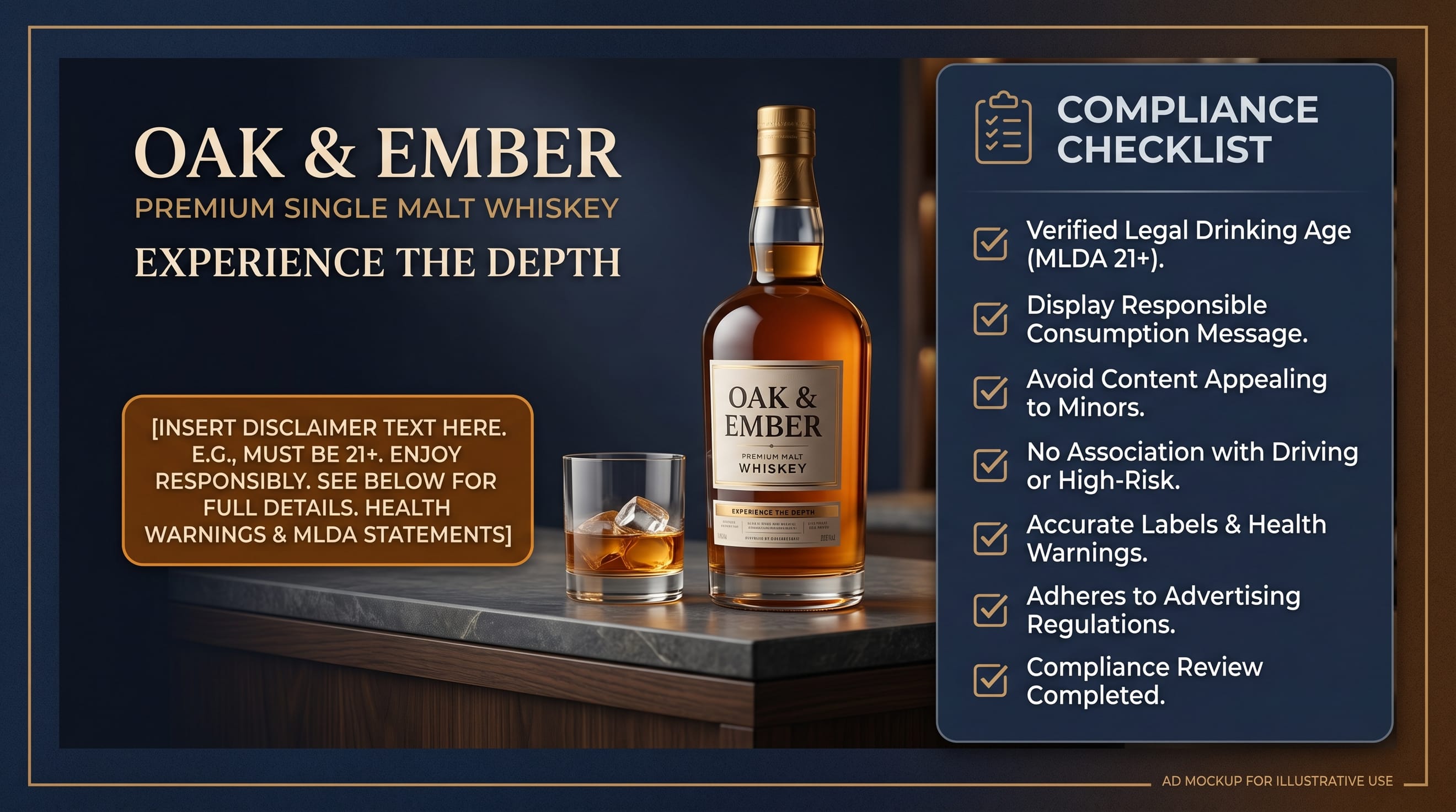
Quick Compliance Checklist:
- Is the advertiser's city and state clearly visible?
- Does the product type match the COLA exactly?
- Is the ABV stated clearly if required for that specific spirit category?
The "Drink Responsibly" Messaging: More Than a Tagline
We’ve all seen it—the tiny text at the bottom of a TV spot or the quick flash at the end of a YouTube ad. Drink responsibly messaging has become a staple of the industry, but is it actually required by law? The answer is more nuanced than a simple "yes" or "no."
While federal law doesn't strictly mandate the specific phrase "Drink Responsibly" in every digital ad, industry self-regulatory bodies like the Distilled Spirits Council of the United States (DISCUS) and the Beer Institute make it a requirement for their members. These organizations represent the vast majority of the market, and their "Code of Responsible Practices" is the gold standard that platforms like Meta and Google use to judge your content.
Interestingly, a study by the Journal of Public Health found that while 87% of alcohol ads included a responsibility message, the size and placement often rendered them "unnoticeable" to the average viewer. This is exactly what regulators are trying to change. They are no longer satisfied with "invisible" compliance; they want these warnings to be "conspicuous and legible."
Are you treating your responsibility message as a legal hurdle or as a part of your brand’s commitment to consumer safety? When you view it as the latter, it becomes much easier to integrate it into your creative workflow naturally.
Platform-Specific Rules: Meta, Google, and Beyond
One of the biggest headaches for modern marketers is that alcohol advertising requirements change depending on where the ad is appearing. What works for a billboard in Times Square will not work for a Sponsored Story on Instagram.
Meta (Facebook & Instagram): Meta requires that all alcohol ads be targeted to users aged 21+ (in the US). But beyond targeting, they also scan for "responsible drinking" cues. If your ad depicts excessive consumption or shows people who appear to be under 21, their AI will flag it. Meta’s internal data suggests that ads with clear, legible disclaimers have a 12% higher approval rate on the first submission compared to those that bury the text.
Google Ads: Google is notoriously strict about "landing page compliance." It’s not enough for the ad itself to have a disclaimer; the website the ad links to must have a robust Age Gate. If your landing page doesn't require a birthdate entry, Google will likely suspend your entire ad account, not just the individual creative.
TikTok: The newcomer to the space has some of the strictest rules. TikTok generally prohibits alcohol advertising in many regions, and where it is allowed, the alcohol ad warnings must be incredibly prominent, often requiring a permanent overlay throughout the entire video duration.
Platform Requirements at a Glance:
- Meta: Strict 21+ targeting + "Drink Responsibly" text.
- Google: Mandatory Age Gate on landing pages + no "health benefit" claims.
- YouTube: 5-second "static" disclaimer often required for longer-form content.
- Twitter (X): Requires pre-approval from their policy team before any alcohol ads can run.
Placement, Font Size, and the "Legibility" Trap
You’ve included the name, the address, the class, and the warning. You’re good to go, right? Not so fast. The TTB and FTC have very specific rules about how those alcohol ad disclaimers are presented. If a regulator has to squint to read your warning, it doesn't count.
The general rule of thumb is that mandatory statements must be "conspicuous" and "readily legible." For digital ads, this usually means the text must be in a color that contrasts sharply with the background. Placing white text over a pale yellow cocktail? That’s a recipe for a compliance violation. You need a high-contrast ratio to ensure the text stands out.
Then there is the issue of font size. While there isn't a "one size fits all" pixel count, the TTB suggests that mandatory information be at least the size of the most common text in the ad, excluding the brand name. In video content, the alcohol ad warnings should remain on screen long enough for an average person to read them—usually at least two to three seconds for a standard sentence.
Statistics from legal audits show that "poor legibility" is the #1 reason for ad creative rejection in the spirits industry. Are you letting a design choice put your entire budget at risk?
The Global Dilemma: Crossing Borders with Alcohol Ads
In our connected world, your Instagram ad might be seen by someone in London, Paris, or Tokyo. This is where alcohol advertising requirements become truly dizzying. If you are a global brand, a "one-size-fits-all" disclaimer strategy is a dangerous game.
Take France, for example. Their "Loi Évin" is one of the strictest sets of alcohol laws in existence. It dictates not only what you can say but also what images you can use. In France, you generally cannot show people enjoying the drink; you can only show the product itself and its ingredients. The mandatory health warning must also take up a specific percentage of the ad's surface area.
In the UK, the ASA (Advertising Standards Authority) is equally vigilant. They recently reported a 25% increase in complaints related to alcohol ads on social media, largely driven by influencers failing to include the proper "AD" labels alongside mandatory drinking warnings. If you're working with influencers, their lack of a disclaimer is your legal problem.
How do you manage 50 different sets of rules for 50 different countries? For many, the answer is "geo-fencing" their content, but even that isn't foolproof. The only real solution is a localized compliance strategy that adapts your alcohol ad disclaimers based on the viewer's location.
The Future of Compliance: AI and Automation
By now, you might be thinking: "I’m a marketer, not a paralegal. How am I supposed to keep track of all this?" You’re not alone. The sheer volume of content required for modern digital marketing makes manual compliance checks nearly impossible to scale.
This is where the industry is shifting toward automation. AI-powered tools can now scan an ad creative in milliseconds, checking for font size, contrast ratios, mandatory keywords, and even the "age" of the actors in the video. By using technology to handle the "boring" legal stuff, creative teams are free to focus on what they do best: storytelling.
Research suggests that companies using automated compliance workflows reduce their "time-to-market" for new campaigns by up to 40%. Instead of waiting days for a legal review, they get instant feedback. In an era where "trending" content has a shelf life of about 24 hours, that speed is a massive competitive advantage.
Are you still relying on a manual spreadsheet and a prayer to keep your ads compliant? Or are you ready to let technology do the heavy lifting?
Why It Matters: Protecting Your Brand's Bottom Line
At the end of the day, alcohol ad disclaimers aren't just about avoiding fines. They are about brand integrity. In a world where consumers are increasingly conscious of corporate responsibility, being transparent about your product builds trust.
When you follow alcohol advertising requirements to the letter, you are telling your audience—and the regulators—that you are a professional, high-quality brand that cares about its community. You are protecting your "license to operate." One major scandal involving "irresponsible" advertising can lead to calls for stricter legislation that could affect the entire industry for decades.
Remember, the goal of a disclaimer isn't to hide. It's to inform. When done correctly, a disclaimer doesn't ruin a beautiful ad; it anchors it in reality and gives it the legal "green light" it needs to reach its full potential.
Actionable Takeaways for Your Next Campaign
- Double-check your COLA: Ensure every word of your "Class and Type" matches your federal label approval.
- Test for Contrast: Use an online contrast checker to ensure your disclaimer text is actually readable against your background.
- Audit Your Influencers: Make sure every partner post includes the necessary #Ad and "Drink Responsibly" messaging.
- Stay Platform-Aware: Adjust your disclaimer placement for each platform (e.g., higher up on TikTok to avoid being covered by the UI).
- Automate the Process: Use tools that can flag compliance issues before you spend a dime on ad spend.
The Easy Way to Stay Compliant
Navigating the maze of alcohol ad disclaimers doesn't have to be a headache. If you're tired of the manual checks and the constant fear of a TTB audit, it might be time to look at how automation can simplify your life. At Hawtads, we’ve built an AI-powered platform specifically designed to handle the heavy lifting of ad creative compliance for regulated industries like yours.
We help you ensure that every pixel, every word, and every warning is exactly where it needs to be, so you can focus on building your brand and selling your product. Compliance doesn't have to be the "no" department—with the right tools, it can be your secret weapon for faster, safer, and more effective marketing.
Ready to take the guesswork out of your next campaign? Let’s make sure your ads are as smooth as the spirits you’re selling.