
Writing Ad Copy That Passes Compliance Review the First Time
The Compliance Purgatory: Why Your Best Ads Are Getting Rejected You’ve spent weeks researching your audience. You’ve crafted a hook that stops the scroll, and your creative team has delivered a visual masterpiece. You hit "Publish" with high hopes, only to wake up the next morning to a sea of re
The Compliance Purgatory: Why Your Best Ads Are Getting Rejected
You’ve spent weeks researching your audience. You’ve crafted a hook that stops the scroll, and your creative team has delivered a visual masterpiece. You hit "Publish" with high hopes, only to wake up the next morning to a sea of red text: Ad Rejected.
It’s a frustrating cycle that many marketers in regulated industries—like fintech, healthcare, and legal services—know all too well. This "compliance purgatory" doesn't just hurt your feelings; it hurts your bottom line. Every hour your ad sits in review or gets bounced back is an hour of lost revenue and wasted momentum.
Did you know that in highly regulated sectors, nearly 30% of digital ads require at least one round of revisions before they are approved? Writing compliant ad copy isn't just about following rules; it’s about understanding the delicate balance between persuasion and protection. In this guide, we’ll show you how to write copy that satisfies the regulators without losing its creative edge.
Why "Compliant Ad Copy" is Your New Competitive Advantage
In the early days of digital marketing, "disruption" was the buzzword. Brands tried to see how far they could push the envelope before getting a tap on the shoulder from the FTC or Meta’s automated bots. Today, the landscape has shifted. Compliance is no longer a hurdle to clear; it’s a competitive advantage.
When you master the art of writing regulated ad copy, you gain speed. While your competitors are stuck in a three-week back-and-forth with their legal departments, you’re already scaling your winning creatives. Speed to market is the ultimate lever in high-stakes advertising.
According to a recent industry report, companies that automate their compliance workflows see a 40% reduction in time-to-market for new campaigns. By baking compliance into your writing process from day one, you aren't just avoiding fines—you're outrunning the competition. Have you ever considered that your legal team could be your greatest marketing asset if you gave them the right copy to work with?
Understanding the "Invisible" Gatekeepers
Before you pen a single word, you need to know who you’re actually writing for. It isn't just your customer. You’re writing for a triumvirate of gatekeepers: the government regulators (like the FTC, FDA, or FINRA), the platform algorithms (Meta, Google, TikTok), and finally, your internal legal counsel.
Each gatekeeper has a different set of priorities. The FTC cares about "truth in advertising." Meta cares about "user experience" and avoiding "personal attributes." Your legal team cares about "risk mitigation." Compliant advertising copy must satisfy all three simultaneously.
A staggering 74% of consumers say they lose trust in a brand if an ad makes a claim that feels exaggerated or unverified. This means the regulators are actually aligned with your customers. They want honesty. When you write with transparency, you aren't just staying compliant; you're building a brand that people actually trust with their money and health.
The Golden Rule: Avoid the "Absolute" Trap
If there is one thing that triggers a compliance flag faster than anything else, it’s the use of superlatives and absolutes. Words like "guaranteed," "best," "only," and "never" are magnets for rejection. Why? Because in a regulated world, nothing is 100% certain.
Instead of saying "The Best Way to Save for Retirement," try "A Smarter Approach to Retirement Planning." Instead of "Guaranteed Weight Loss," try "Clinically Backed Support for Your Weight Management Journey." See the difference? You’re still communicating value, but you’re doing it with nuance.
- Swap "Will" for "May" or "Can": "This tool will increase your ROI" becomes "This tool is designed to help you increase ROI."
- Avoid "Free" unless it’s truly free: If there are strings attached, use "Included with your subscription" or "Trial period."
- Qualify your claims: If you cite a statistic, add a footnote or a "results may vary" disclaimer in the immediate vicinity.
Platform Nuances: Meta vs. Google vs. TikTok
One of the biggest mistakes marketers make is using the same compliant ad copy across every platform. Each platform’s AI is trained on different sets of "sensitive" keywords. What passes on Google Search might get you banned on Meta.
For example, Meta is notoriously sensitive about "Personal Attributes." You cannot imply that you know something about the user’s personal situation. "Struggling with debt?" is a direct violation. "Solutions for debt management" is a safe alternative. Meta’s AI scans for "you" and "your" when followed by a negative or sensitive condition.
On the other hand, Google focuses heavily on "Speculative Financial Products" and "Misleading Representation." According to Google’s Safety Report, they blocked or removed over 5.2 billion ads in a single year for policy violations. A huge chunk of those were for "unreliable claims."
Are you tailoring your tone to the platform’s specific sensitivities? TikTok, for instance, requires a more "native" feel, but their compliance bots are increasingly aggressive toward healthcare claims that sound too "medical." The key is to stay conversational but cautious.
The Art of the Disclaimer: Making the Fine Print Work
Disclaimers shouldn't be an afterthought. In writing regulated ad copy, the disclaimer is often what allows the creative hook to exist in the first place. The trick is to make the disclaimer feel like a natural part of the brand voice rather than a legal "gotcha."
The FTC’s ".com Disclosures" guidelines state that disclosures must be "clear and conspicuous." You can't hide them in a tiny font that matches the background color. However, you can integrate them into your copy using "linking language."
For example, "Our users see an average of 20% growth* (*See full study details here)" is much more effective than a block of legal text at the bottom of an image. It shows the reader—and the regulator—that you have the receipts to back up your claims. Transparency actually increases conversion rates by reducing the "skepticism barrier."
Three Tips for Effective Disclaimers:
- Proximity: Keep the disclaimer as close to the claim as possible.
- Prominence: Ensure the text is readable on mobile devices.
- Clarity: Use plain English, not "legalese."
Substantiation: The "Receipts" of Ad Copy
In the world of compliant ad copy, if you can’t prove it, you can’t say it. This is known as "substantiation." Before you publish an ad that claims your software "saves users 10 hours a week," do you have the data to prove it? If a regulator knocks on your door, can you produce a study, a survey, or a white paper?
A recent survey found that 62% of marketing teams don't have a centralized "claims library." This leads to different copywriters making slightly different claims, which creates a nightmare for compliance audits. When you build a library of pre-approved, substantiated claims, you empower your writers to move fast without breaking things.
Think of substantiation as your armor. It protects you from the "deceptive advertising" label. When you’re writing regulated ad copy, always ask yourself: "What is the source for this statement?" If the answer is "I just thought it sounded good," it’s time to rewrite.
Visual Compliance: When Images Contradict Your Copy
It’s a common trap: your copy is 100% compliant, but your image or video tells a different story. Compliance bots and human reviewers look at the "net impression" of the ad. If your copy says "Individual results may vary" but your video shows a man winning the lottery and buying a yacht, the ad will be rejected for being misleading.
In the financial sector, showing "stacks of cash" or "luxury lifestyle" imagery is often flagged as an unrealistic expectation of success. In healthcare, "before and after" photos are the fastest way to get an account flagged. Your visuals must support your compliant ad copy, not undermine it.
Are your visuals promising a result that your product can't realistically deliver for every single user? If so, you’re playing a dangerous game with your ad account’s health. Consistency between text and image is the secret sauce to first-time approval.
The Power of "Soft" Language
We often think that "soft" language is weak. In marketing, we’re taught to be bold and assertive. But in regulated industries, "soft" language is your best friend. It allows you to be persuasive while remaining strictly within the lines of compliant advertising copy.
Consider the word "Help." - "This app fixes your credit." (High risk, likely rejection) - "This app is designed to help you manage your credit journey." (Low risk, compliant)
Consider the word "Potential." - "Earn $5,000 a month." (High risk, income claim) - "Explore the potential to grow your side income." (Low risk, aspirational)
By shifting your focus from the result to the process or the tool, you stay compliant. You aren't promising a specific outcome; you're offering a resource that makes that outcome possible. This subtle shift in ad copy compliance tips can be the difference between a scaling campaign and a banned account.
Leveraging AI for Compliance Automation
The manual review process is the biggest bottleneck in modern advertising. Your creative team writes the copy, sends it to the legal team, waits three days, gets it back with red lines, and repeats the process. It’s slow, expensive, and prone to human error.
This is where technology is changing the game. AI-powered platforms are now capable of scanning your copy against thousands of platform policies and industry regulations in seconds. Instead of guessing if your copy is compliant, you can get a "compliance score" before you ever hit submit.
At Hawtads, we’ve seen that teams using AI-driven compliance checks can increase their creative output by 5x while virtually eliminating "accidental" policy violations. Imagine a world where your writers get real-time feedback on their writing regulated ad copy. No more waiting on legal. No more rejected ads. Just pure, unhindered scale.
How much more could your team achieve if they weren't afraid of the "Rejected" button? Automation doesn't replace the writer; it gives the writer a safety net, allowing them to be more creative within the safe zones of compliance.
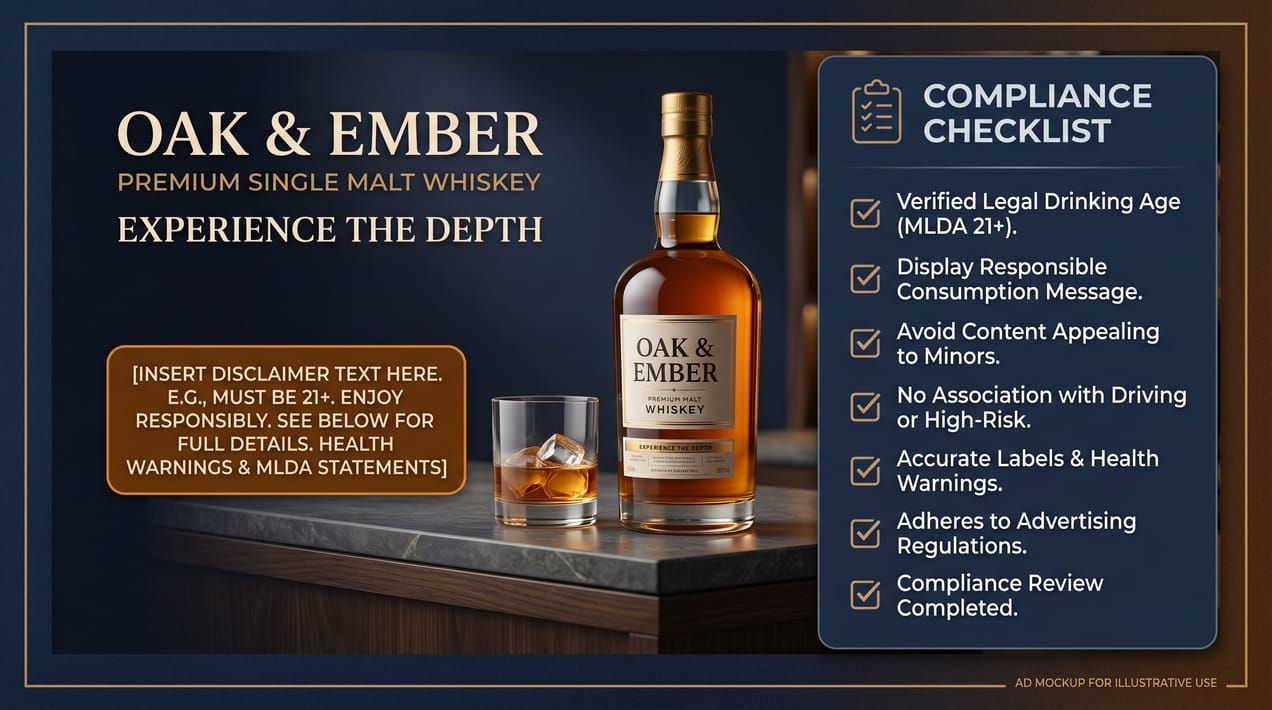
Your Actionable Compliance Checklist
To ensure your compliant ad copy passes review the first time, run every piece of creative through this quick checklist:
- Check for Absolutes: Did I use words like "guaranteed," "best," or "always"?
- Verify Personal Attributes: Am I speaking to a sensitive trait or about a solution? (The "You" test).
- Review Substantiation: Do I have a source for every statistic and claim in this ad?
- Match Visuals to Copy: Does the image imply a result that the text doesn't explicitly promise?
- Platform Alignment: Have I adjusted the tone for the specific platform's unique "red flag" keywords?
- Disclaimer Check: Is the necessary fine print clear, conspicuous, and nearby?
Moving From "Rejected" to "Running"
Writing compliant ad copy doesn't have to be a creative death sentence. In fact, some of the most successful ads in history were written under strict constraints. Constraints breed creativity. When you know exactly where the boundaries are, you can play right up to the edge with confidence.
The secret to winning in regulated industries isn't about finding a way to "beat the system." It’s about building a system that embraces compliance as a core part of the creative process. By focusing on transparency, using "soft" language, and leveraging the right tools, you can turn your compliance department from a "Department of No" into a "Department of Go."
If you're tired of the manual back-and-forth and want to see how AI can streamline your writing regulated ad copy, it might be time to look at how automation can do the heavy lifting for you. At Hawtads, we help brands in the most scrutinized industries launch faster and stay compliant without breaking a sweat. After all, the best ad in the world is the one that actually gets to run.
Ready to stop guessing and start scaling? See how Hawtads can transform your compliance workflow today.