
Compliance Debt Is the New Technical Debt: Why Marketing Teams Can't Ignore It
The Hidden Cost of Moving Too Fast Imagine this: Your team just spent six weeks crafting a high-octane social media campaign. The creative is stunning, the copy is punchy, and the initial engagement metrics are through the roof. Then, the email arrives. It isn't a congratulatory note from the CEO; i
The Hidden Cost of Moving Too Fast
Imagine this: Your team just spent six weeks crafting a high-octane social media campaign. The creative is stunning, the copy is punchy, and the initial engagement metrics are through the roof. Then, the email arrives. It isn't a congratulatory note from the CEO; it’s a formal inquiry from a regulatory body or a stern warning from your legal department.
Suddenly, the campaign is paused. Your "winning" creative is flagged for a minor disclosure omission that exists in 400 other active ads. This is the moment you realize you’ve been operating with significant compliance debt marketing.
We’ve all heard of technical debt—the cost of choosing an easy, short-term solution today instead of a better approach that takes longer. In the world of modern advertising, compliance debt is its equally dangerous cousin. It’s the accumulation of "we’ll fix that disclaimer later" or "legal doesn't need to see this small tweak" decisions that eventually come due with interest.
According to a recent industry report, the average cost of a data breach or significant regulatory non-compliance event now exceeds $4.45 million. But for marketing teams, the cost isn't just financial; it’s the erosion of brand trust and the grinding halt of innovation.
What Exactly Is Compliance Debt?
In the software world, technical debt happens when developers ship code quickly to meet a deadline, knowing they’ll have to refactor it later. In marketing, compliance debt is the result of prioritizing speed and "growth at all costs" over regulatory rigor.
It’s the collection of outdated terms and conditions, the missing state-specific disclosures in financial ads, or the use of "guaranteed" in a health supplement ad without the proper substantiation. You might get away with it for a month, or even a year. But as your ad library grows, so does the debt.
Are you currently running ads that you *know* wouldn't pass a rigorous audit today? If the answer is yes, you’re essentially taking out a high-interest loan against your company’s future.
Statistics show that regulatory agencies are becoming more aggressive. In 2023 alone, the FTC's enforcement actions resulted in billions of dollars in refunds to consumers. This isn't just a "big company" problem anymore; small and mid-sized firms are increasingly in the crosshairs.
The High Cost of "We'll Fix It Later"
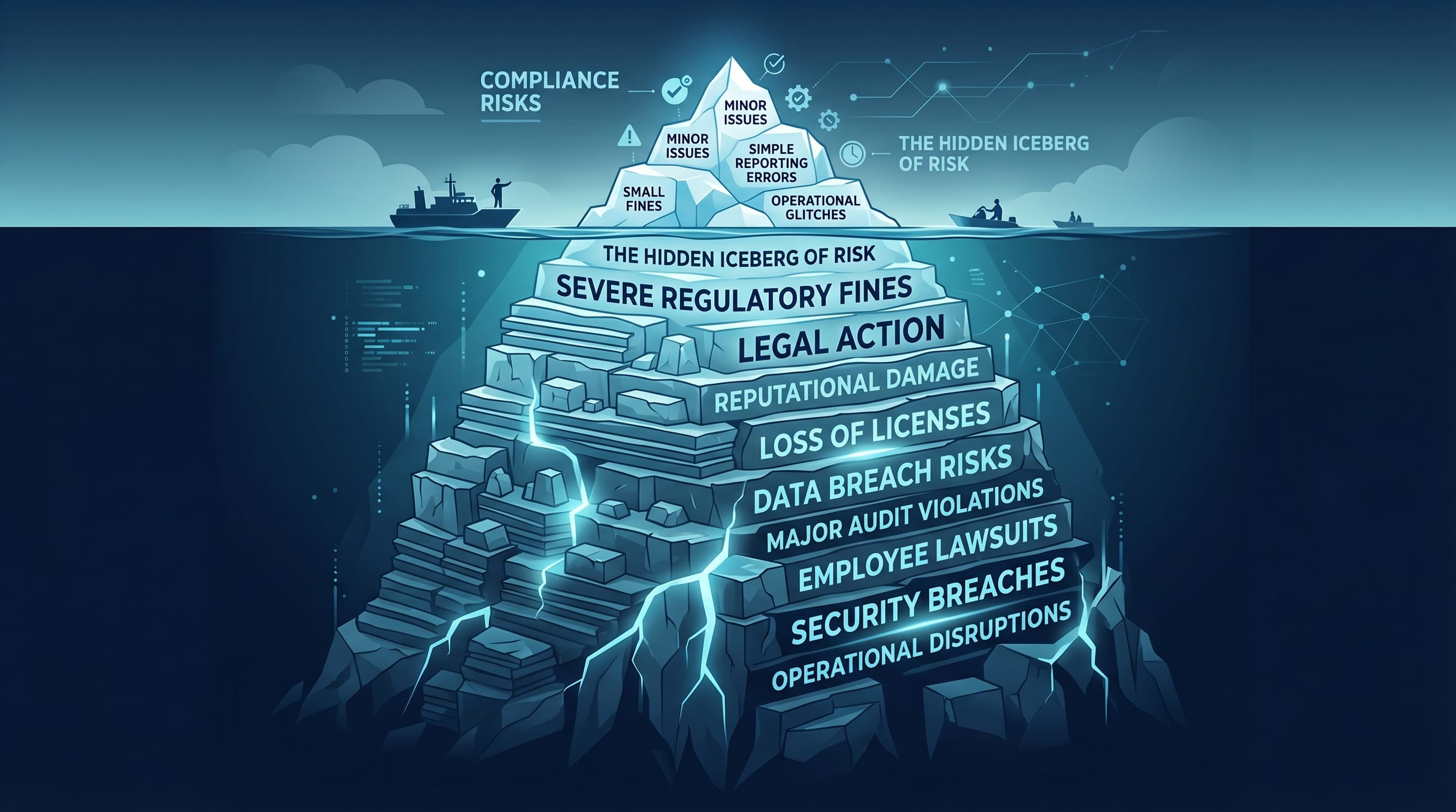
The danger of marketing compliance risk is that it is often invisible until it becomes a catastrophe. Unlike a broken link or a 404 error, a compliance error can sit quietly in your Facebook Ad Library for months, slowly building a case for a regulator.
When you ignore compliance in favor of speed, you aren't actually moving faster. You are simply deferring the work—and the work becomes much harder when it’s forced upon you by a legal mandate.
Think about the manual labor involved in updating 1,000 active ad creatives because a single word in a disclosure changed. If you haven't automated your compliance strategy advertising, your team will spend weeks in "clean-up mode" instead of "growth mode."
A 2023 survey of CMOs found that nearly 60% of marketing leaders feel that regulatory requirements are slowing down their ability to launch campaigns. This friction is a direct symptom of accumulated compliance debt. When the foundation is shaky, every new floor you build feels more precarious.
Why Marketing Teams Are the New Compliance Officers
In the past, compliance was "Legal's problem." You would send a final PDF to the legal team, they would mark it up with red pen, and you’d grumble about them killing your creativity. But the landscape has changed.
With the explosion of dynamic creative optimization (DCO) and AI-generated content, the volume of assets is too high for any human legal team to review manually. Marketing teams have effectively become the first line of defense.
This shift means that marketers need to understand the nuances of regulatory risk marketing. You need to know why a certain phrase is a "no-go" in California but acceptable in Texas. You need to understand why the SEC cares about the font size of your "past performance" disclaimer.
The stakes are higher than ever. Research from Ponemon Institute suggests that organizations that prioritize compliance integrity save an average of $2.86 million compared to those that take a reactive approach. Can your marketing budget afford to lose that much on preventable errors?
The Speed vs. Safety Paradox in the AI Era
We are currently living through the greatest content explosion in human history. AI tools allow us to generate thousands of ad variations in seconds. This is a dream for performance marketers, but a nightmare for compliance officers.
How do you ensure that an AI-generated headline doesn't accidentally make a medical claim that violates FDA guidelines? How do you verify that every one of those 5,000 variations includes the legally required fine print for the specific region it’s being served in?
This is where the paradox lies: The tools that allow us to move faster also increase the speed at which we accumulate compliance debt. If you are using AI to scale your creative output without using AI to scale your compliance checks, you are essentially driving a Ferrari with no brakes.
Gartner predicts that by 2025, 30% of outbound marketing messages from large organizations will be synthetically generated. Without an automated compliance debt marketing strategy, the risk of a "hallucinated" claim triggering a massive fine is no longer a theoretical worry—it’s a statistical probability.
Identifying Your Compliance Debt: An Audit Checklist
How do you know if you’re drowning in debt? It starts with an honest assessment of your current processes. Most teams find that their debt is hidden in the "small things" that have been overlooked during rapid scaling.
- The Legacy Asset Trap: Are you still running evergreen ads that were approved two years ago? Regulations change, but often our "set it and forget it" campaigns do not.
- The Regional Gap: Are your ads compliant across all jurisdictions? A "one size fits all" approach to disclosures is a recipe for disaster in a fragmented regulatory world.
- The Influencer Blind Spot: Are your third-party creators following FTC disclosure guidelines? You are legally responsible for the content they produce on your behalf.
- The Documentation Void: If a regulator asked for the approval history of a specific ad from six months ago, could you produce it in an hour? If not, you have a documentation debt.
A study by the Global Advertising Lawyers Alliance (GALA) highlighted that "greenwashing" and "dark patterns" are the top targets for regulators in 2024. If your debt includes these types of tactics, the interest rates are about to skyrocket.
The Financial Industry Example: A Warning Tale
Regulated industries like FinTech, Healthcare, and Gaming are the "canaries in the coal mine" for compliance debt. In these sectors, the regulatory risk marketing is so high that a single mistake can lead to the loss of a license.
Consider the recent wave of fines in the cryptocurrency and neobanking sectors. Many of these companies grew at lightning speed, ignoring traditional compliance frameworks. When the regulators caught up, the "debt" was so high that some companies were forced to shut down entirely.
They focused on customer acquisition costs (CAC) and lifetime value (LTV), but they forgot to factor in the cost of compliance. They treated compliance as a barrier to growth rather than a prerequisite for it.
The lesson for all marketers—even those in less regulated spaces—is that the "move fast and break things" era is over. The new mantra is "move fast with guardrails."
How to Pay Down Your Compliance Debt
You can't fix a year's worth of compliance debt overnight. Just like paying off a credit card, it requires a systematic approach. You have to stop the bleeding first, then start chipping away at the principal.
- Stop Creating New Debt: Implement a mandatory compliance check for every new asset. This is where automation becomes your best friend.
- Categorize Your Risk: Not all debt is equal. Identify the ads with the highest spend and the highest regulatory exposure (e.g., those making specific claims) and fix them first.
- Centralize Your Rules: Move away from "tribal knowledge" where one person knows what’s allowed. Create a centralized, digital rulebook that can be updated instantly.
- Automate the Audit: Use technology to scan your active ad libraries. Human eyes can't catch everything, but AI can.
By shifting from a manual review process to an automated one, companies have seen a 40% reduction in time-to-market for new campaigns. Paying down your debt doesn't just lower your risk—it actually restores your speed.
The Role of Automation in Modern Compliance
The only way to truly solve the compliance debt marketing crisis is through technology. We use automation for bidding, for targeting, and for creative generation. It only makes sense to use it for the most critical part of the funnel: staying legal.
Modern platforms can now scan ad copy, images, and video in real-time, comparing them against a database of internal brand rules and external government regulations. This allows your creative team to get instant feedback while they are still in the design phase, rather than waiting for a "no" from Legal three days before launch.
When you automate your compliance strategy advertising, you turn a bottleneck into a competitive advantage. You can launch in new markets faster, experiment with more creative variations, and sleep better at night knowing that your brand's reputation is protected.
Think of it as an automated savings plan. Instead of accumulating debt, you are building "compliance equity" that allows you to scale with confidence.
Turning Compliance from a Burden into a Competitive Advantage
What if compliance wasn't the department that said "no," but the department that enabled you to say "yes" more often? When your compliance process is streamlined and automated, you can react to market trends in hours rather than weeks.
If a competitor gets hit with a regulatory fine, and you are the one brand in the space that is demonstrably "clean," you win the trust of the consumer. In a world of deepfakes and deceptive advertising, transparency and compliance are becoming powerful brand differentiators.
Marketing teams that master this will be the ones that survive the next decade of increased scrutiny. They are the ones who understand that marketing compliance risk isn't just a legal checkbox—it's a core component of customer experience.
Are you ready to stop managing crises and start managing growth? The first step is acknowledging that the debt exists. The second step is choosing the right tools to pay it off.
Future-Proofing Your Marketing Strategy
As we look toward the future, the complexity of advertising regulations will only increase. From the AI Act in Europe to evolving state-level privacy laws in the U.S., the "rules of the road" are being rewritten in real-time.
Relying on manual spreadsheets and email chains to manage compliance is like trying to navigate the ocean with a paper map from the 1700s. You need a GPS. You need a system that updates as the landscape changes.
The companies that thrive will be those that integrate compliance into their creative workflow, not those that treat it as a final hurdle. They will be the companies that recognize that "fast" is only good if you're heading in the right direction.
The Path Forward with HawtAds
The transition from a high-debt environment to a compliant, agile one doesn't have to be painful. It’s about empowering your team with the tools they need to succeed without the fear of a regulatory "gotcha."
At HawtAds, we understand the unique pressures faced by marketing teams in regulated industries. Our AI-powered platform is designed to act as your always-on compliance partner, scanning your ad creatives for risks before they ever reach a customer's screen.
By automating the heavy lifting of compliance, we help you pay down your debt and reclaim your team's creative energy. You focus on the big ideas; we’ll make sure they’re built on a solid, compliant foundation.
Don't let compliance debt be the hidden anchor that sinks your marketing ROI. It’s time to move fast, stay safe, and build a brand that lasts.