
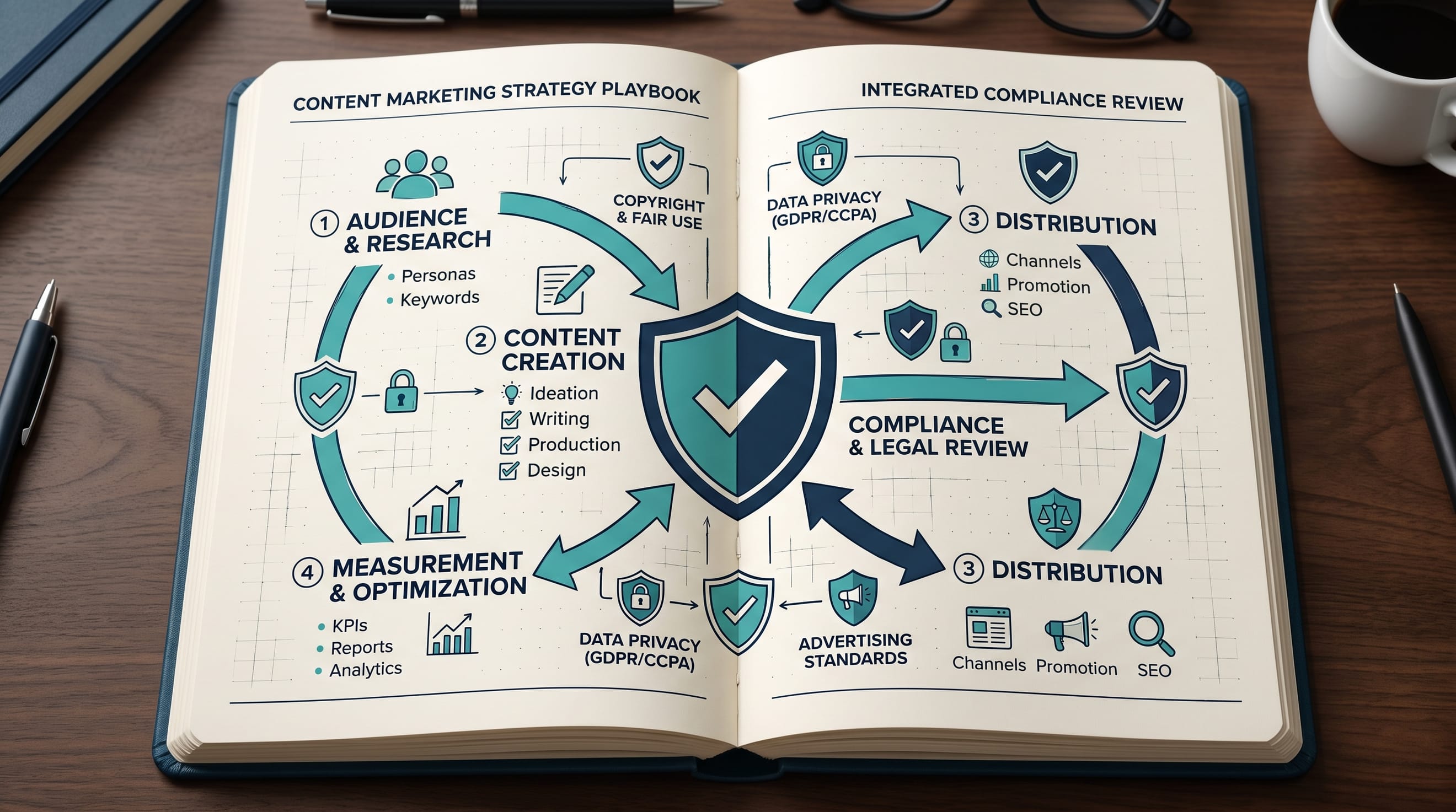
The Compliance-First Content Marketing Playbook for Regulated Brands
The Compliance-First Content Marketing Playbook for Regulated Brands Imagine you’ve spent three weeks crafting the perfect campaign. The copy is punchy, the visuals are thumb-stopping, and the strategy is backed by months of data. You hit "send" to the legal department, feeling confident. Then, fort
The Compliance-First Content Marketing Playbook for Regulated Brands
Imagine you’ve spent three weeks crafting the perfect campaign. The copy is punchy, the visuals are thumb-stopping, and the strategy is backed by months of data. You hit "send" to the legal department, feeling confident. Then, forty-eight hours later, your document comes back looking like a crime scene—slashed with red ink, covered in "cannot say this" comments, and stripped of everything that made it engaging.
If you work in fintech, healthcare, insurance, or gaming, this isn't just a hypothetical scenario. It’s your Tuesday morning. In fact, research shows that marketers in highly regulated sectors spend up to 40% more time in the approval phase than their counterparts in retail or tech. This "compliance tax" doesn't just hurt your feelings; it kills your speed to market and drains your budget.
But what if compliance wasn’t the finish line you tripped over at the end of the race? What if it was the track itself? Adopting a compliance-first content marketing approach allows you to build trust with your audience while keeping the regulators happy. It’s about moving from a culture of "no" to a culture of "know-how."
The High Cost of the "Move Fast and Break Things" Mentality
For years, the mantra in digital marketing was to move fast and break things. In a regulated environment, if you break things, the government breaks you. Whether it’s an SEC fine for a misleading social post or an FDA warning letter for an unsubstantiated health claim, the stakes are incredibly high.
Did you know that the average cost of a non-compliance event for a financial services firm is now upwards of $14 million? That includes fines, legal fees, and the devastating loss of brand equity. When you operate in a space where trust is your primary product, a single compliance slip-up can take years to repair.
Why do so many brands struggle with this? Usually, it’s because compliance is treated as an afterthought. It’s something that happens to the content, rather than something that is built into the content. By shifting to a regulated brand content strategy that prioritizes safety from day one, you actually gain the freedom to be more creative within the "safe" boundaries.
Defining Compliance-First Content Marketing
So, what does it actually mean to be "compliance-first"? It’s a strategic shift where regulatory requirements are integrated into the earliest stages of the creative process. Instead of writing a blog post and asking legal to "bless it," you start with a clear understanding of what the SEC, FINRA, or the FTC allows you to say.
Think of it like building a house. You don't design a glass mansion and then ask the building inspector if it’s safe; you look at the building codes first so you know exactly how much glass you can use. This approach saves time, reduces friction between departments, and ensures your message remains consistent across every channel.
How often does your creative team sit down with your legal team before a campaign starts? If the answer is "never," you’re missing the most critical step in compliant content marketing. When these two teams speak the same language, the "red ink" starts to disappear.
Building a Regulated Brand Content Strategy That Works
The foundation of any successful strategy in a regulated industry is documentation. You cannot expect your writers, designers, or agency partners to guess what is "safe." You need a living, breathing Compliance Style Guide. This document should go beyond font sizes and brand colors to include specific "Forbidden Phrases" and "Required Disclosures."
According to a recent industry survey, companies with a documented compliance workflow are 3x more likely to launch campaigns on time compared to those who rely on ad-hoc email approvals. Documentation provides a "single source of truth" that eliminates the subjective "I don't like how this feels" feedback from legal reviewers.
Your strategy should also account for the different levels of risk associated with different content types. A top-of-funnel educational blog post about "How Inflation Works" carries much less risk than a bottom-of-funnel landing page for a specific investment product. By tiering your content risk, you can streamline the approval process for low-stakes assets and save your legal team’s energy for the high-stakes stuff.
The Anatomy of a Compliant Creative Workflow
What does a content marketing compliance workflow actually look like in practice? It starts with a brief that includes "Legal Guardrails." Before a single word is written, the writer should know the mandatory disclaimers that need to be included and the specific claims that are off-limits.
- Step 1: The Pre-Brief: Identify the regulatory body (e.g., FDA, FTC) and the specific rules that apply to this campaign.
- Step 2: The Modular Build: Use pre-approved "blocks" of copy for disclaimers and product descriptions.
- Step 3: Automated Screening: Run the draft through an AI-powered compliance tool to catch obvious errors before a human sees it.
- Step 4: The Legal Review: A final check for nuance and context by a qualified professional.
- Step 5: The Audit Trail: Document every version and every approval in a centralized system.
Is your current process decentralized across Slack, email, and Google Docs? If so, you’re not just being inefficient—you’re creating an audit nightmare. A centralized workflow ensures that if a regulator ever asks, "Who approved this ad on October 12th?", you can provide the answer in seconds.
Navigating the Nuances of Different Platforms
Compliance isn't a one-size-fits-all game. What works on a long-form blog post won't work in a 15-second TikTok video. Regulators are increasingly looking at "prominence and proximity"—the idea that disclaimers must be easy to see and close to the claim they are qualifying.
On Meta (Facebook and Instagram), this might mean including a disclosure in the first two lines of your caption so it isn't hidden behind the "See More" link. On TikTok, it might mean using an on-screen text overlay that stays visible for the duration of the claim. The platform’s UI dictates your compliance strategy as much as the regulation itself.
Statistics show that 68% of consumers feel that brands in regulated industries are "intentionally confusing" with their fine print. By making your disclosures clear and integrated into the design, you aren't just staying legal—you’re building a more transparent, trustworthy brand. Why hide the truth in a tiny font when you can use it to build credibility?
The Role of AI in Content Marketing Compliance
We live in an era where brands are expected to produce more content than ever before. But how do you scale your output without scaling your legal team? This is where technology becomes your greatest ally. AI is no longer just for generating text; it’s for protecting your brand.
Modern tools can now scan images, videos, and copy for potential regulatory violations in milliseconds. For example, Hawtads uses AI to automate the creative compliance process, ensuring that every ad you run meets industry standards before it ever hits the platform. This doesn't replace the human legal expert, but it does handle the "boring" parts of their job, like checking for missing disclaimers or banned words.
Data indicates that AI-assisted compliance reviews are 90% faster than manual reviews alone. By automating the initial screening, you allow your legal team to focus on high-level strategy rather than playing "Where's Waldo" with fine print. Are you still relying on manual spreadsheets to track your ad creative compliance?
Influencer Marketing: The Wild West of Regulation
If there is one area where regulated brands frequently stumble, it’s influencer marketing. When you hand over your brand voice to a third party, you are still responsible for what they say. The FTC has been incredibly clear: "I didn't know they would say that" is not a valid legal defense.
A recent study found that nearly 50% of influencers in the healthcare space fail to properly disclose their partnerships. For a regulated brand, this is a ticking time bomb. Your regulated brand content strategy must include a strict vetting process and a mandatory "Compliance 101" training for every influencer you partner with.
You need to provide influencers with "Must-Say" and "Never-Say" lists. More importantly, you need a system to monitor their content in real-time. If an influencer goes rogue on a Live stream, you need to have a plan in place to address it immediately. Compliance doesn't end when you hit "publish"; it’s an ongoing commitment to monitoring.
Managing the "Dark Post" Dilemma
In the world of performance marketing, "dark posts" (ads that don't appear on your brand's main timeline) are a staple. However, they are also a compliance nightmare. Because these posts are often numerous and varied for A/B testing, they can easily slip through the cracks of a traditional legal review process.
Every single iteration of an ad—even if you’re just changing the background color or one word in the headline—needs to be compliant. Regulators don't care if a mistake only appeared in a small test cell; the violation is the same. This is why automated versioning and review tools are essential for any brand running performance ads at scale.
Did you know that some financial brands run over 5,000 unique ad variations per month? Manually reviewing that volume is impossible. Without a compliance-first content marketing infrastructure, you are essentially playing Russian Roulette with your brand’s reputation every time you launch a new test.
Measuring Success Beyond "Not Getting Fined"
How do you know if your compliance strategy is working? Most brands use "zero fines" as their only KPI. While that’s a great start, it doesn’t tell the whole story. You should also be tracking your "Time to Market" and your "Review-to-Approval Ratio."
If your creative-to-legal feedback loop takes two weeks, you’re losing the ability to jump on trends or respond to market changes. A successful compliant content marketing program should actually speed up your production. When the rules are clear and the tools are in place, there are fewer rounds of revisions and fewer "back to the drawing board" moments.
Furthermore, look at your consumer sentiment. Brands that handle compliance with transparency often see higher engagement rates. When you stop trying to hide the "catch" and start being upfront about the terms and conditions, your audience feels more secure. In the end, compliance is just another word for integrity.
The Future of Compliance: Proactive vs. Reactive
The regulatory landscape is only getting more complex. With the rise of state-level privacy laws like CCPA and the global impact of GDPR, the "old way" of doing things is no longer sustainable. Brands that remain reactive—waiting for a problem to occur before fixing it—will eventually be left behind.
The future belongs to proactive brands. These are the companies that view compliance as a competitive advantage. If you can launch a compliant campaign in 48 hours while your competitor takes three weeks, you win. If you can build a reputation for being the most "honest" brand in a crowded market, you win.
As AI continues to evolve, the barrier between "creative" and "legal" will continue to blur. We are moving toward a world where the software you use to design an ad will also tell you if it’s legal in real-time. This isn't science fiction; it’s the direction the industry is moving. The question is: is your brand ready to lead, or are you still waiting for the red ink?
Your Actionable Compliance-First Checklist
Ready to overhaul your approach? Here are five steps you can take this week to move toward a compliance-first model:
- Audit your current workflow: Map out exactly how an idea becomes a live ad. Where are the bottlenecks?
- Create a "Safe List": Compile a library of pre-approved phrases, disclaimers, and imagery that your team can use without a fresh legal review.
- Schedule a "Peace Treaty" meeting: Sit down with your legal lead. Ask them what their biggest frustrations are with the creative team and listen.
- Set a "Speed KPI": Measure how long it takes for an asset to move through the approval pipeline and set a goal to reduce it by 20%.
- Invest in Automation: Look for tools that can handle the repetitive, manual parts of the compliance check so your humans can focus on big-picture strategy.
Streamlining the Path to Growth
Marketing in a regulated industry doesn't have to feel like running a hurdle race in a suit of armor. When you embrace a compliance-first mindset, you’re not just avoiding trouble; you’re building a more efficient, more creative, and more trustworthy organization.
The goal isn't to eliminate the rules—it's to master them. By integrating regulatory knowledge directly into your creative process and leveraging the right technology, you can stop fearing the "red ink" and start focusing on what you do best: connecting with your audience and growing your brand.
If you’re tired of the manual review grind and want to see how AI can transform your compliance workflow, it’s time to look at modern solutions. At Hawtads, we help regulated brands bridge the gap between high-performance creative and iron-clad compliance. Because in today’s market, you shouldn’t have to choose between moving fast and staying safe.