Why Regulated Brands Can't Just 'Boost a Post': The Compliance Gap in Social Advertising
The Siren Song of the "Boost Post" Button You’ve seen it. It sits there, glowing in a friendly shade of blue right beneath your latest organic post. It promises more reach, higher engagement, and a direct line to your target audience for the price of a fancy lunch. For most businesses, clicking that
The Siren Song of the "Boost Post" Button
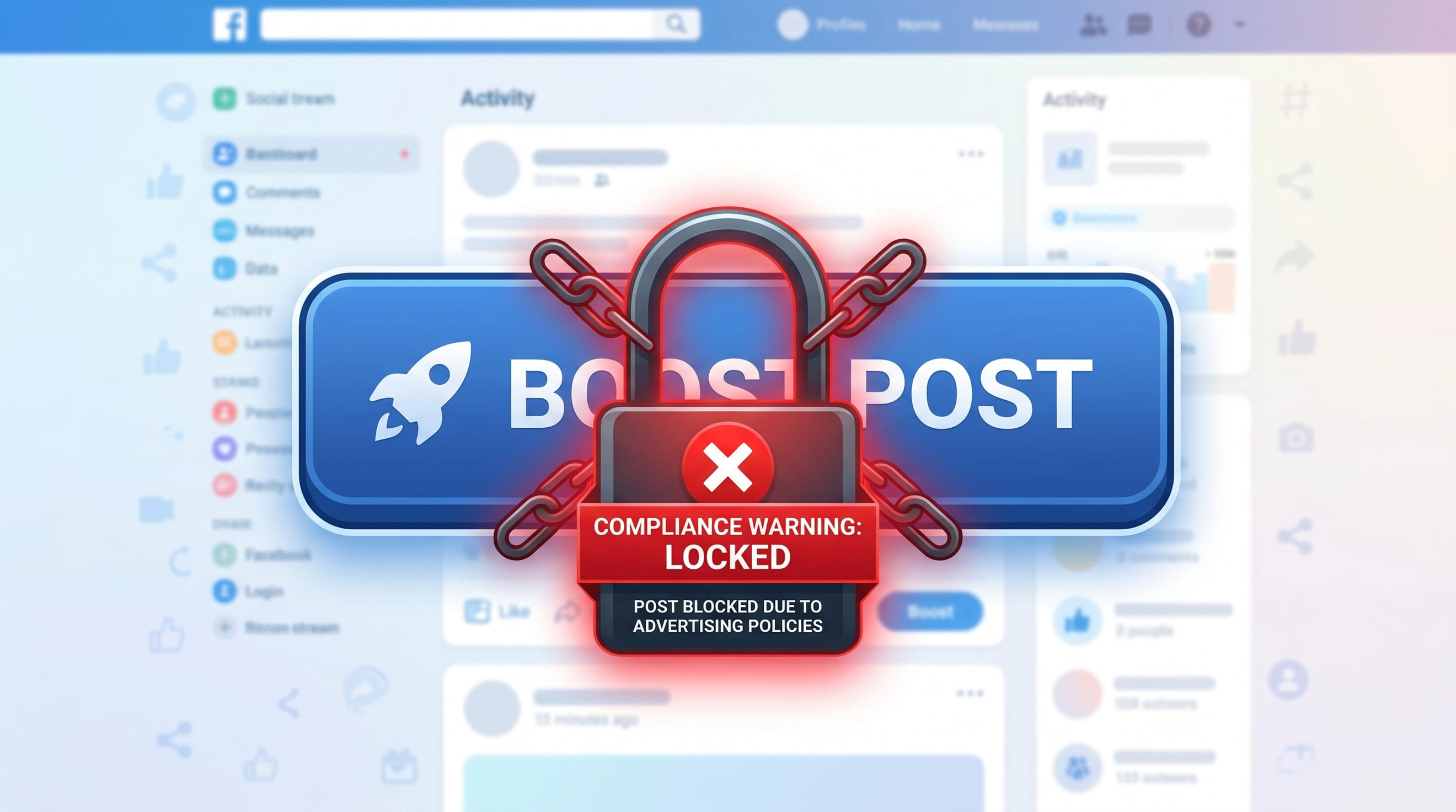
You’ve seen it. It sits there, glowing in a friendly shade of blue right beneath your latest organic post. It promises more reach, higher engagement, and a direct line to your target audience for the price of a fancy lunch. For most businesses, clicking that button is a no-brainer. But for you, working in a highly regulated industry, that button is a siren song that could lead your brand straight onto the rocks of a regulatory audit.
Whether you’re in FinTech, healthcare, insurance, or iGaming, the rules of regulated social media advertising are vastly different from those governing a local coffee shop. While the "Boost Post" function is designed for speed and simplicity, it lacks the structural integrity required to satisfy the SEC, FINRA, the FDA, or the FTC. Have you ever wondered why your legal team breaks into a cold sweat every time you mention a quick social promotion?
It’s because compliance isn't just about what you say; it’s about how you prove you said it, who you said it to, and where you kept the receipts. According to recent industry reports, social media compliance violations have seen a 45% increase in regulatory focus over the last three years, as agencies catch up with digital-first marketing strategies.
The Convenience Trap: Why "Easy" is Dangerous
The fundamental problem with boosted post compliance is that native social media tools are built for the masses, not for the scrutinized. When you boost a post directly from the Facebook or Instagram app, you are bypassing the robust review workflows that usually govern your "Dark Ads" (ads created in the back-end Ads Manager). This creates a "Compliance Gap"—a space where unvetted content can live and breathe in the public eye without the necessary oversight.
Think about your current approval process. Does it involve a spreadsheet? An endless chain of emails with "Final_v2_APPROVED_ActualFinal.mp4" in the subject line? When you hit "Boost," you’re often taking an organic post—which might have been approved for a general audience—and turning it into a paid solicitation. In the eyes of regulators, that change in status changes the rules of the game entirely.
Recent data suggests that nearly 60% of financial services firms admit to having "gaps" in their social media archiving processes. When you boost a post on the fly, are you ensuring that the specific version of that ad, including its targeting parameters and the exact timestamp of its promotion, is being captured in an immutable archive? If the answer is "I think so," you might already be at risk.
The Disappearing Disclosure Act
In regulated social media advertising, the "one-click rule" or specific disclosure requirements are non-negotiable. If you’re promoting a high-yield savings account or a new medical treatment, the "fine print" isn't just a suggestion—it's a legal requirement. The problem with boosted posts is that the UI often truncates text or hides disclosures behind a "See More" link that doesn't meet the "clear and conspicuous" standard required by the FTC.
Are you confident that your mandatory disclosures remain visible across all devices when a post is boosted? Most native tools optimize for engagement, which often means cropping images or shortening text to fit a user’s feed. If your risk disclaimer gets cropped out of a mobile view, you’ve just created a non-compliant advertisement, regardless of how the original post looked on your desktop.
Consider this: The FTC recently updated its guidelines to emphasize that disclosures must be "unavoidable." A boosted post that hides a disclosure under a fold or places it in a comment thread simply won't cut it during an audit. How much is that extra engagement worth if it comes with a six-figure fine?
Targeting: The Fair Lending and Housing Minefield
When you use regulated brand social media strategies, who you *don't* show your ad to is just as important as who you do. Native boosting tools often encourage "Lookalike" audiences or broad interest-based targeting to maximize your spend. However, for industries like banking or real estate, these "black box" algorithms can inadvertently lead to discriminatory practices.
The Department of Housing and Urban Development (HUD) has been incredibly clear: algorithms that exclude certain demographics—even if the exclusion wasn't intentional—violate the Fair Housing Act. When you click "Boost," you often have less granular control over these exclusions than you do in a full campaign suite. You are essentially handing the keys of your compliance to an AI that was built to sell t-shirts, not to navigate the complexities of the Equal Credit Opportunity Act (ECOA).
Statistics show that ad platforms have had to remove thousands of targeting categories in recent years to prevent bias. Yet, the risk remains. If your boosted post is optimized for "people interested in luxury travel," are you inadvertently redlining lower-income zip codes in a way that violates lending laws? Without a dedicated compliance layer, you might not know until the subpoena arrives.
The Audit Trail: Screenshots are Not Documentation
If a regulator knocks on your door tomorrow and asks for every version of a boosted post from eighteen months ago, including the comments that were moderated and the targeting criteria used, could you provide it in an hour? For many brands, the answer is a frantic search through old Slack messages and blurry screenshots.
In social ad regulations, the "record-keeping" requirement is often the undoing of otherwise great marketing teams. FINRA Rule 2210 and SEC Rule 204-2 require firms to maintain records of all "communications with the public." A boosted post is a high-stakes communication. Native platforms do not make it easy to export these records in a format that satisfies a regulatory examiner.
In fact, a study by Smarsh found that "failure to maintain records" is one of the top three reasons for fines in the financial sector. Relying on a social platform’s internal "Ad Library" is a dangerous game. Those libraries are often incomplete, lack targeting data, and can be changed or deleted by the platform without notice. You need an independent, third-party record of everything you put into the world.
The Speed vs. Safety Paradox
The real reason we love the "Boost Post" button is speed. Modern social media moves at the speed of culture. If a topic is trending, you want to be part of the conversation *now*, not after a fourteen-day legal review. This is where the "Compliance Gap" becomes a "Performance Gap." Regulated brands often feel they have to choose between being relevant and being safe.
This delay is costly. Research indicates that ad relevance scores can drop by as much as 20% for every week an ad sits in an approval queue. By the time your legal team approves a "timely" post, the window of opportunity has often closed. This leads to the "Shadow Marketing" temptation—where teams boost posts quietly, hoping they won't get caught, just to keep up with the competition.
But what if you didn't have to choose? What if the compliance check happened in milliseconds instead of days? This is the promise of regulated social media advertising in the age of AI. By moving away from manual, human-only reviews and toward automated, rule-based systems, brands can finally close the gap between the "Boost" button and the "Compliance" requirement.
Why Manual Moderation is Failing
Let’s talk about the comments section. When you boost a post, you’re not just promoting your content; you’re promoting the conversation happening underneath it. For a regulated brand, a user comment can quickly turn a compliant ad into a non-compliant one. If a user makes a fraudulent claim about your product in the comments of your boosted post and you don't address it, regulators may view that as "adoption" of the claim by the brand.
Manual moderation is a losing battle. The average social media manager cannot monitor every thread 24/7 for potential "promotional" language or "medical advice" left by random users. Yet, the social ad regulations in many jurisdictions hold the brand responsible for the "context" of their advertisements. You need a system that can flag and hide non-compliant user-generated content in real-time, something the standard "Boost" workflow simply doesn't offer.
Did you know that top-tier brands see an average of 150 comments per hour on high-spend boosted posts? No human team can vet those against a 50-page compliance manual at that scale. Automation isn't just a luxury; it's a necessity for survival in a regulated digital space.
Closing the Compliance Gap
So, how do you move forward? Does this mean you can never boost a post again? Not necessarily. It means you need to change the infrastructure behind the button. To succeed in regulated social media advertising, you need to move from a reactive posture to a proactive one. This involves three key shifts:
- Pre-Approved Creative Libraries: Instead of boosting on a whim, use a centralized repository of pre-cleared assets where the disclosures and targeting parameters are already baked in.
- Automated Guardrails: Implement tools that sit between your social media manager and the "Publish" button, scanning for prohibited keywords, missing disclaimers, or risky targeting choices before the ad goes live.
- Immutable Archiving: Ensure every interaction, every version, and every targeting set is automatically captured in a searchable, tamper-proof environment.
The goal is to make compliance invisible. When the "right way" is also the "easy way," your team will naturally follow the path of least resistance. The danger of the "Boost Post" button isn't the button itself; it's the lack of a safety net beneath it.
As the landscape of regulated brand social media continues to evolve, the brands that win will be those that can iterate the fastest without breaking the law. They will be the ones who treat compliance as a competitive advantage rather than a bureaucratic hurdle.
A Better Way to Grow
You shouldn't have to sacrifice your brand’s growth because your industry is complex. The "Compliance Gap" is real, but it’s also solvable. By integrating AI-driven oversight into your workflow, you can give your marketing team the freedom to use social media as it was intended: fast, engaging, and effective.
At Hawtads, we’ve built the bridge over that gap. We understand that in regulated industries, an ad isn't just a piece of creative—it’s a legal document. Our platform automates the tedious parts of ad creative compliance, ensuring that your social media presence is as safe as it is impactful. From real-time monitoring to automated audit trails, we help you hit that "Boost" button with total confidence.
Ready to see how AI can transform your compliance workflow? Let’s talk about how you can start scaling your social advertising without the regulatory headache. Your legal team will thank you, and your ROI will, too.
Actionable Takeaways for Your Team:
- Audit your "Boosts": Review the last 90 days of boosted posts. Do they all have the required disclosures visible on mobile?
- Check your Archives: Ask your IT or Compliance team to produce the full targeting criteria for a specific ad from last year. If they can't, you have a gap.
- Centralize Approvals: Move away from email-based approvals and toward a system that links the approved creative directly to the social platform.