Why Your Ad Account Keeps Getting Suspended (And How to Appeal)
The Red Bar of Death: Why Your Ad Account Keeps Getting Suspended You pour your coffee, open your laptop, and navigate to your dashboard, ready to see the conversions from last night’s campaign. Instead, you’re met with a cold, red banner at the top of the screen: "Your ad account has been suspen
The Red Bar of Death: Why Your Ad Account Keeps Getting Suspended
You pour your coffee, open your laptop, and navigate to your dashboard, ready to see the conversions from last night’s campaign. Instead, you’re met with a cold, red banner at the top of the screen: "Your ad account has been suspended for violating our policies."
Your heart drops. Your traffic stops. Your revenue flatlines. If you’ve spent any time in the world of digital marketing—especially in regulated industries like finance, health, or gaming—you know this feeling all too well. Having your ad account suspended isn't just an inconvenience; it’s a threat to your business’s survival.
But why does it keep happening? Is it a personal vendetta by a Silicon Valley algorithm, or are you missing something fundamental in your compliance strategy? According to recent industry reports, Meta alone disables over 1 billion fake or non-compliant accounts every year, and legitimate businesses are often caught in the crossfire of these automated sweeps.
In this guide, we’re going to pull back the curtain on why platforms like Meta and Google are so ban-happy. We’ll look at the common triggers, the "hidden" reasons you haven't considered, and most importantly, the exact steps you need to take for a successful ad account appeal.
The Rise of the Machines: Understanding Automated Enforcement
The first thing you have to understand is that a human probably didn't ban you. With millions of ads running simultaneously, platforms rely on AI "bots" to police the ecosystem. These bots are programmed to be risk-averse, meaning they would rather ban a hundred innocent accounts than let one malicious one slip through.
Did you know that nearly 90% of initial enforcement actions on major ad platforms are triggered by automated systems? These algorithms scan your creative, your copy, your landing page, and even your payment history in milliseconds. If they find a pattern that resembles past "bad actors," they pull the trigger first and ask questions later.
This is why your Meta ad account banned notification often feels so vague. The bot identified a "signal," but it doesn't have the nuance to explain it to you in plain English. It simply sees a violation of "Unacceptable Business Practices" and shuts you down.
Creative Compliance: The #1 Reason for Suspensions
Most advertisers think their ads are fine because they aren't selling anything illegal. However, compliance is about more than just the product; it’s about the promise. If your creative uses "Before and After" photos, makes "guaranteed" income claims, or uses sensationalist language, you are painting a target on your back.
In the health and wellness space, for example, Meta’s "Personal Health" policy is notoriously strict. A 2023 study found that nearly 25% of ad rejections in the supplement industry were due to "Sensational Content" or "Misleading Claims" that the advertiser thought were perfectly normal marketing speak.
Are you using "you" language in a way that implies a personal attribute? Asking "Are you tired of being broke?" can trigger a suspension because it highlights a negative financial state of the user. The platforms want users to feel good while scrolling, not judged. When your creative crosses that line, your ad account suspended status becomes an inevitability.
The Landing Page Trap
You could have the most compliant ad in the world, but if your landing page is a mess, you’re going down. Google and Meta don't just look at the ad; they follow the "scent" all the way to your checkout page. If your landing page doesn't match the promise of the ad, or if it lacks essential legal disclosures, you're in trouble.
Common landing page triggers include:
- Redirects: Using "bridge pages" or cloaking to hide the final destination.
- Broken Links: If your Privacy Policy or Terms of Service links return a 404 error, you look like a scammer to the bots.
- Exit Pop-ups: Google Ads, in particular, hates intrusive overlays that prevent a user from leaving the page easily.
According to Google’s 2023 Safety Report, the company blocked or removed 5.5 billion ads and suspended over 12.7 million advertiser accounts. A significant portion of these were due to "Destination Requirements"—meaning the landing page was the culprit, not the ad itself.
Regulated Industries: Playing the Game on "Hard Mode"
If you’re in CBD, iGaming, Crypto, or Finance, you aren't just fighting the standard bots; you're fighting specialized compliance layers. These industries are "high-risk" for platforms because they carry legal liabilities. One wrong word in a crypto ad can result in a massive fine for the platform, so they keep you on a very short leash.
For these industries, manual reviews are more common, but so is the dreaded "permanent" Google Ads suspension. These platforms often require specific certifications (like LegitScript for pharmacies or G2 for financial services) before you’re even allowed to spend a dollar.
Have you audited your creative for "restricted keywords"? Sometimes, even mentioning a word like "cure" or "investment" in the wrong context can trigger a flag. This is where Hawtads becomes an essential part of your workflow. By using AI to pre-scan your creatives against specific industry regulations, you can catch these "landmine" words before the platform bots do.
The Hidden Triggers: It’s Not Always the Ad
Sometimes, your ads are perfect, but your "digital footprint" is messy. Platforms look at your account's reputation holistically. If you have a history of late payments, or if you’re using a credit card that was previously associated with a banned account, you will be flagged immediately.
Another hidden trigger is "IP Contamination." If you’re managing your ads from a public Wi-Fi or using a cheap VPN that shares IP addresses with bad actors, the platform might assume you are part of a bot farm. Consistency is key. Logging in from three different countries in 24 hours is a surefire way to see your ad account suspended for "suspicious activity."
Statistically, accounts with two-factor authentication (2FA) enabled and a clean payment history are 60% less likely to face automated suspensions for "security reasons." It’s the boring stuff—the administrative hygiene—that often keeps the lights on.
How to Write an Ad Account Appeal That Actually Works
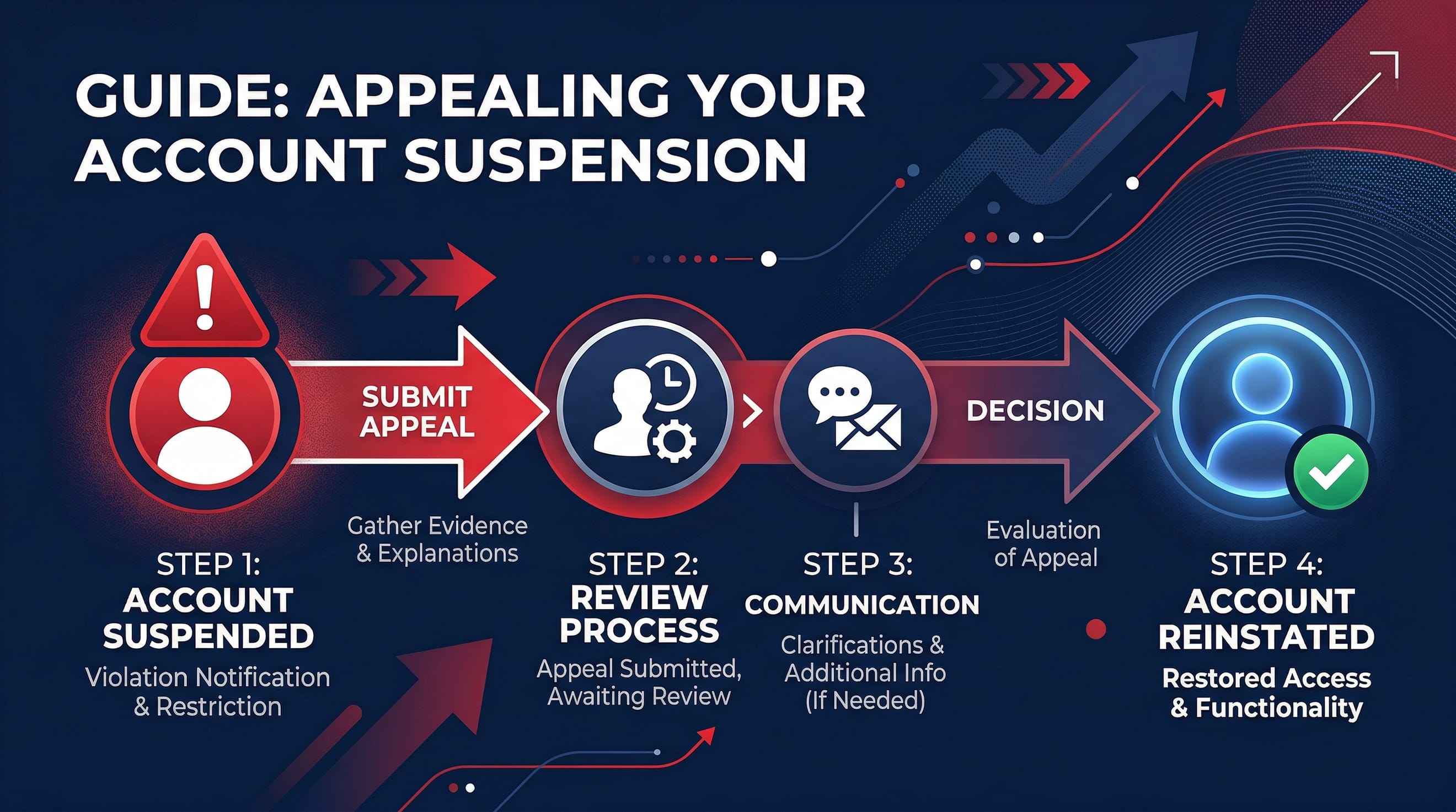
So, the worst has happened. You’re suspended. Your first instinct is to scream at the support rep or send a frantic message saying "I didn't do anything wrong!" Stop. That is the fastest way to get your appeal rejected.
When you file an ad account appeal, you are often communicating with a low-level reviewer who has a quota to fill. You need to make their job easy. Here is the framework for a professional, effective appeal:
- Acknowledge and Respect: Start by acknowledging the platform's commitment to user safety. "I understand and respect Google's policies regarding financial services..."
- Identify the (Possible) Mistake: Don't play dumb. Say, "I believe my ad for [Product] may have been flagged for [Policy], specifically due to the wording in the second headline."
- State Your Fix: "I have already removed the offending creative and updated our landing page to include the required disclosures."
- Provide Proof: Attach screenshots of the changes. If you have a business license or certification, attach that too.
Avoid using "legal" language or threatening to sue. It doesn't work. Treat the reviewer like a colleague you’re trying to help. A calm, evidence-based appeal has a significantly higher success rate than an emotional one.
The Cost of Downtime: Why Prevention is the Only Real Strategy
An ad account suspended for just 48 hours can cost a medium-sized brand thousands in lost revenue and throw off the "learning phase" of your active campaigns. When you finally get back online, your CPAs are often higher because the algorithm has to re-learn who your audience is.
The reality of modern digital advertising is that you cannot afford to be reactive. You need a "Compliance-First" mindset. This means building a library of pre-approved creatives and using tools that simulate the platform's own scanning technology.
Research shows that brands that use automated compliance checks reduce their ad rejection rate by over 40%. By catching the "Personal Attributes" or "Misleading Claims" before you hit publish, you maintain a "High Trust" score with the platform, which makes you less likely to be hit by the next automated sweep.
Building a "Ban-Proof" Infrastructure
If you want to stay in the game long-term, you need redundancy. Never rely on a single ad account or a single platform. Diversification is your insurance policy. If your Meta ad account is banned, you should have Google Ads or TikTok Ads already running so your business doesn't go dark.
Furthermore, consider using a Business Manager structure that separates your assets. Don't run five different brands out of one ad account. If one brand gets flagged for a policy violation, it could take down the entire house of cards. Keep your "clean" accounts separate from your "testing" accounts.
Is your team trained on the latest policy updates? Meta and Google change their terms of service almost monthly. What was allowed in 2023 might be a ban-able offense in 2024. Regular audits of your creative strategy are not just a good idea—they are a requirement for survival.
The Future of Compliance: AI vs. AI
We are entering an era where the platforms use AI to catch you, so you must use AI to protect yourself. The complexity of modern regulations—especially with the rise of the Digital Services Act (DSA) in Europe—means that human manual review is no longer enough to keep up.
This is where the intersection of automation and compliance becomes powerful. Imagine a system that knows the Meta policy manual better than any human and can flag a "Before and After" image the moment it's uploaded to your creative folder. That is how you stay ahead of the "Red Bar of Death."
By leveraging technology to handle the "boring" parts of compliance, your team can focus on what actually matters: storytelling, strategy, and scaling your ROI.
Actionable Takeaway: Your 3-Step Protection Plan
If you want to stop the cycle of suspensions, you need to change your workflow today. Here is your immediate checklist:
- Audit Your Current Creative: Look for "you" language, sensationalist claims, and missing disclosures on landing pages.
- Clean Up Your Digital Footprint: Enable 2FA on all accounts and ensure your payment methods are consistent and updated.
- Prepare Your "Appeal Kit": Have your business licenses, ID, and utility bills ready in a folder. If a suspension hits, you can appeal within minutes, not days.
Managing compliance in regulated industries doesn't have to feel like walking through a minefield. While the platforms are getting stricter, the tools to navigate them are getting smarter. At Hawtads, we’ve built an AI-powered platform specifically designed to help brands in "high-risk" industries automate their creative compliance and stay on the right side of the algorithms.
Don't wait for the next red banner to appear. Take control of your compliance strategy now, and keep your ads running exactly where they belong: in front of your customers.

)